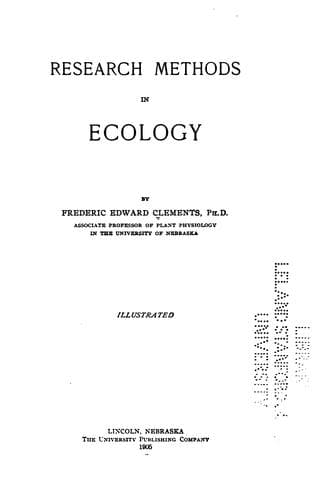
Research methods in ecologyClements, Frederic E. (Frederic Edward)
Science
Research methods in ecology
Clements, Frederic E. (Frederic Edward)
Plant ecology; Plant ecology -- Methodology
=156. The quantitative relation of absorption and transpiration.=
Burgerstein[11] has summarized the results of various investigators in
the statement “that between the quantitative absorption of water on the
one hand and emission on the other there exists no constant parallelism
or proportion,” and he has cited the work of Kröber, and of Eberdt in
proof. This statement holds, however, only for short periods of a few
hours, or more rarely, a day, and even here its truth still remains to
be conclusively demonstrated. The discrepancy between absorption and
transpiration for a short period is often greater than for a longer
time, but it is evident that a transient change in behavior or a small
error in the method would inevitably produce this result. Eberdt found
the discrepancy for a few hours to be 1–2 ccm. in an entire plant of
_Helianthus annuus_, while for a whole day the water absorbed was 33.57
ccm. and the water lost 33.98 ccm. Kröber’s experiments with cut
branches of _Asclepias incarnata_ showed a maximum difference for 12
hours of 2.5 ccm., but the discrepancy for the first 24 hours was 1 ccm.
and for the second 1.9 ccm. In both cases, the potometer was employed.
Consequently, as will be shown later, Eberdt’s results are not entirely
trustworthy, while those of Kröber, made with cut stems, are altogether
unreliable. Hence, it is clear that the discrepancy is slight for a
period of several days or weeks, and that it may be ignored without
serious error, except in a few plants that retain considerable water as
cell-sap, in consequence of extremely rapid growth. Accordingly, the
amount of transpiration, which may be readily and accurately determined,
can be employed as a measure of absorption that is sufficiently accurate
for nearly all purposes. The truth of this statement may be easily
confirmed. It is evident that the amount of water absorbed equals the
amount transpired plus that retained by the plant as cell-sap, or used
in the manufacture of organic compounds. In plants not actively growing,
the amount lost equals that absorbed, as already shown in the experiment
with _Helianthus_. According to Gain[12], Dehérain has found that a
plant rooted in ordinary soil transpired 680 kg. of water for each
kilogram of dry substance elaborated. In _Helianthus annuus_, the dry
matter is 10 per cent of the weight of the green plant. A well-grown
plant weighing 1,000 grams, therefore, consists of 100 grams of dry
matter and 900 of water. The length of the growing period for such a
plant is approximately 100 days, during which it transpires 68 kilograms
of water. Assuming the rate of transpiration and of growth to be
constant, the plant transpires 680 grams daily, adds 9 grams to its
cell-sap, and 1 gram to its dry weight. The amount of water in a gram of
cellulose and its isomers is about ⅗. Consequently, the total water
absorbed daily by the plant is 689.6 grams. The 680 grams transpired are
Public-domain text, read in full here on John Shaqi.
Reviews
Reviews
No reviews yet
Be the first to share your thoughts on this work.
Elsewhere in the archive
Join the Discussion
Join the discussion
Sign in to leave a comment or review.
Sign InorCreate an account