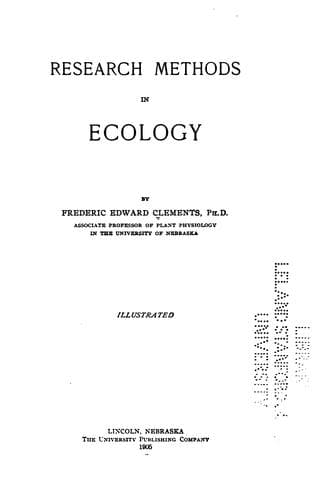
Research methods in ecologyClements, Frederic E. (Frederic Edward)
Science
Research methods in ecology
Clements, Frederic E. (Frederic Edward)
Plant ecology; Plant ecology -- Methodology
force that affects the shape of the cell will have a corresponding
influence upon the position of the chloroplasts. When it is considered
that in many leaves these four factors play some part in determining the
arrangement of the plastids, it is not difficult to understand that
anomalies frequently appear.
It may be laid down as a general principle that chloroplasts tend to
place themselves at right angles to rays of diffuse light and parallel
to rays of sunlight. This statement is borne out by an examination of
the leaves of typical sun and shade species, or of sun and shade forms
of the same species. Cells which receive diffuse light, i. e., sponge
cells, normally have their rows of plastids parallel with the leaf
surface, while those in full sunlight place the rows at right angles to
the surface. This disposition at once suggests the generally accepted
view that chloroplasts in diffuse light are placed in such a way as to
receive all the light possible, while those in sunlight are so arranged
as to be protected from the intense illumination. Many facts support
this statement with respect to shade leaves, but the need of protection
in the sun leaf is not clearly indicated. The regular occurrence of
normal chloroplasts in the guard cells seems conclusive proof that full
sunlight is not injurious to them. Although the upper wall of the outer
row of palisade cells is usually free from chloroplasts, yet it is not
at all uncommon to find it covered by them. These two conditions are
often found in cells side by side, indicating that the difference is due
to the presence of carbon dioxide and not to light. In certain species
of monocotyledons, the arrangement of the chloroplasts is the same in
both halves of the leaf, and there is no difference between the sun and
shade leaves of the same species. The experimental results obtained with
concentrated sunlight, though otherwise conflicting, seem to show
conclusively that full sunlight does not injure the chloroplasts of sun
plants, and that the position of plastids in palisade cells is not for
the purpose of protection. This arrangement, which is known as
_apostrophe_, is furthermore often found in shade forms of heliophytes.
In typical shade species, and in submerged plants, the disposition of
plastids on the wall parallel with the leaf surface, viz., _epistrophe_,
is more regular, but even here there are numerous exceptions to the
rule.
Public-domain text, read in full here on John Shaqi.
Reviews
Reviews
No reviews yet
Be the first to share your thoughts on this work.
Elsewhere in the archive
Join the Discussion
Join the discussion
Sign in to leave a comment or review.
Sign InorCreate an account