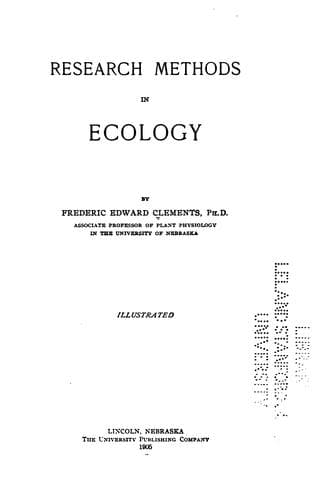
Research methods in ecologyClements, Frederic E. (Frederic Edward)
Science
Research methods in ecology
Clements, Frederic E. (Frederic Edward)
Plant ecology; Plant ecology -- Methodology
=177. Influence of chloroplasts upon form and structure.= The beginning
of all modifications produced by light stimuli must be sought in the
chloroplast as the sensitized unit of the protoplasm. Hence, it seems a
truism to say that the number and arrangement of the chloroplasts
determine the form of the cell, the tissue, and the leaf, although it
has not yet been possible to demonstrate this connection conclusively by
means of experiment. In spite of the lack of experimental proof, this
principle is by far the best guide through the subject of adaptations to
light, and in the discussion that follows, it is the fundamental
hypothesis upon which all others rest. The three propositions upon which
this main hypothesis is grounded are: (1) that the number of
chloroplasts increases with the intensity of the light; (2) that in
shaded habitats chloroplasts arrange themselves so as to increase the
surface for receiving light; (3) that chloroplasts in sunny habitats
place themselves in such fashion as to decrease the surface, and
consequently the transpiration due to light. In these, there can be
little doubt concerning the facts of number and arrangement, since they
have been repeatedly verified. The purpose of epistrophe and apostrophe,
however, can not yet be stated with complete certainty.
The stimulus of sunlight and of diffuse light is the same in one
respect, namely, the chloroplasts respond by arranging themselves in
rows or lines on the cell wall. The direct consequence of this is to
polarize the cell, and its form changes from globoid to oblong. This
effect is felt more or less equally by both palisade and sponge cells,
but the disturbing influence of aeration has caused the polarity of the
cells to be much less conspicuous in the sponge than in the palisade
tissue. While the cells of both are typically polarized, however, they
assume very different positions with reference to incident light. This
position is directly dependent upon the arrangement of the plastids as
determined by the light intensity. In consequence, palisade cells stand
at right angles to the surface and parallel with the impinging rays; the
sponge cells, conversely, are parallel with the epidermis and at right
angles to the light ray. Some plants, especially monocotyledons, exhibit
little or no polarity in the chlorenchym. As a result the leaf does not
show a differentiation into sponge and palisade, and the leaves of sun
and shade ecads are essentially alike in form and structure. The form of
the leaf is largely determined by the chloroplasts acting through the
cells that contain them. A preponderance of sponge tissue produces an
extension of leaf in the direction determined by the arrangement of the
plastids and the shape of the sponge cells, viz., at right angles to the
light. Shade leaves are in consequence broader and thinner, and
sometimes larger, than sun leaves of the same species. A preponderance
Public-domain text, read in full here on John Shaqi.
Reviews
Reviews
No reviews yet
Be the first to share your thoughts on this work.
Elsewhere in the archive
Join the Discussion
Join the discussion
Sign in to leave a comment or review.
Sign InorCreate an account