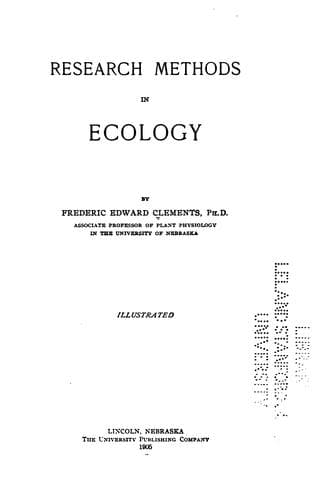
Research methods in ecologyClements, Frederic E. (Frederic Edward)
Science
Research methods in ecology
Clements, Frederic E. (Frederic Edward)
Plant ecology; Plant ecology -- Methodology
=192. Methods.= All field experiments in evolution are based upon a
change of habitat. The latter is accomplished by the modification of the
habitat itself, or by the transfer of the species to one or more
different habitats, or to different areas of the same habitat. In both
cases the choice of habitats is made upon the basis of efficient
differences of water-content or light. Saline situations do not
constitute an exception, since the chresard is really the effective
stimulus. Cultures at different altitudes, which afford striking
results, appear to concern several factors, but in the final analysis,
water-content and humidity are alone found to be really formative.
Cultures may furthermore be distinguished as simple or reciprocal.
Simple cultures are those in which a species is transferred to one or
more habitats, or in which a habitat is modified in one or more ways.
Reciprocal cultures are possible only with polydemic species, or with
endemics after ecads have been produced by experiment. Modification or
transfer is made in the usual way, but reciprocally, i. e., the original
form is transferred to the habitat of the ecad, and the latter to the
habitat of the former; or the shade in which some individuals of the
ecad are growing may be destroyed, and at the same time individuals of
the type may be shaded. Both transfer and modification may be applied to
the same species, but since the same measured change of factor can be
obtained in either way, the use of both is undesirable, with the
exception of the rare cases where they serve as checks upon each other.
The transfer of a seed or plant is so much simpler and more convenient
that this method is the one regularly used. It sometimes happens,
however, that a change of water-content or light intensity is readily
and conveniently made, and is desirable for other reasons.
It is evident that both transfer and modification require that the
factor records of the various habitats or areas be as full as possible,
at least so far as water-content, humidity, and light are concerned. In
the case of the areas that are to be modified, these factors are
determined before the change is made. Afterward they are read from time
to time during the growing season, and are also checked by readings made
near at hand in the unmodified formation. The readings made in the
beginning should correspond closely to the check readings, but in case
of disagreement the latter are to be taken as conclusive.
Public-domain text, read in full here on John Shaqi.
Reviews
Reviews
No reviews yet
Be the first to share your thoughts on this work.
Elsewhere in the archive
Join the Discussion
Join the discussion
Sign in to leave a comment or review.
Sign InorCreate an account