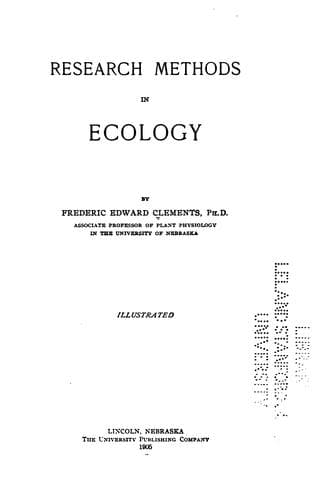
Research methods in ecologyClements, Frederic E. (Frederic Edward)
Science
Research methods in ecology
Clements, Frederic E. (Frederic Edward)
Plant ecology; Plant ecology -- Methodology
=198. The need of exact methods.= The use of instruments in the study of
the habitat has made it evident that the loose methods of descriptive
ecology were altogether inadequate to the accurate investigation of the
formation. This feeling has been heightened by the recognition of the
fact that vegetation exhibits both development and structure, and is, in
consequence, open to exact methods of inquiry. In the search for
feasible methods, it was quickly seen that the quadrat, first[20] used
for determining the abundance of species, furnished the key to the
problem. Accordingly, the principle underlying it, viz., that of
intimate detailed study and record, was developed and extended in such a
way as to give rise to a number of methods of precision. These have been
applied in the field for several years with signal success, and they are
here described in the conviction that they constitute a satisfactory
system, if not, indeed, the only one for the exact study of formations.
There has been a growing appreciation of the fact that the superficial
methods of descriptive ecology made it impossible to build upon such a
foundation, and they, indeed, were making actual progress in the field
of ecology more and more difficult. Ecologists have now begun to see
clearly that precise methods are as indispensable in the habitat as they
are to the study of the structure and modification of the plant. For
some reason, however, they have been slow to perceive that accuracy in
the investigation of the cause, the habitat, is a fruitless task unless
it be followed by corresponding exactness in the study of the effect,
the formation. After having urged the fundamental necessity of
instrumental methods, for six or seven years, both in season and out of
season, the writer does not feel called upon to further plead the cause
of the quadrat. The final acceptance of the instrument was inevitable if
progress were to be made in the habitat, and it is just as obvious that
the quadrat must be accepted if the study of the habitat is to bear
fruit in the interpretation of the formation. The use of the quadrat
does not mean that the general methods of descriptive ecology are all to
be discarded, whether they have value or not. The statement that quadrat
methods are indispensable signifies merely that they must be used for
research work in the development and structure of vegetation. They are
not necessary in reconnaissance, nor do they displace general methods of
real value. The use of the latter in even a supplementary way will
gradually be discontinued, however, as fields become smaller by reason
of increase in the number of workers, and as the need for precise
methods becomes more universally felt.
Public-domain text, read in full here on John Shaqi.
Reviews
Reviews
No reviews yet
Be the first to share your thoughts on this work.
Elsewhere in the archive
Join the Discussion
Join the discussion
Sign in to leave a comment or review.
Sign InorCreate an account