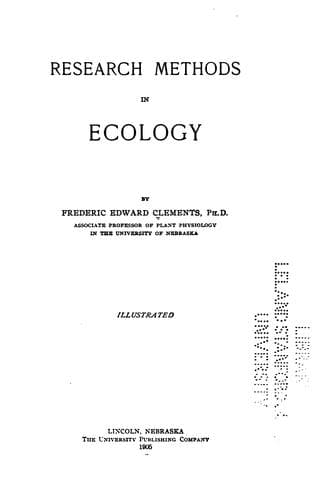
Research methods in ecologyClements, Frederic E. (Frederic Edward)
Science
Research methods in ecology
Clements, Frederic E. (Frederic Edward)
Plant ecology; Plant ecology -- Methodology
point out the reasons why all charts and maps should be based upon the
decimal system of scales. Experience will furnish the very best of
arguments.
=232. Color scheme.= The first requisite for the graphic representation
of formations, regions, etc., is that each class of formations be
invariably indicated by the same color. It is also necessary that the
colors and shades be easily distinguishable, and it is at least
desirable that they be referred to the different classes in some
consistent sequence. Uniformity in all these points is greatly to be
desired at the hands of all ecologists. Here, as in the case of the
standard scale, uniformity will be found the more desirable the more
impossible it is made by ignoring it. In the use of color to represent
regions and provinces, on maps too small to indicate formations, the
color of each division is represented by the color of its dominant
formation; thus the prairie province is colored ochroleucus on account
of the color used to represent prairie formations, the boreal-subalpine
zone atrovirens on account of the typical coniferous forests, etc. No
endeavor has been made to take account of the various types of
formations, e. g., the different coniferous forests, as this is a
problem to be worked out for more local maps in various shades of dark
green, etc. The following color scheme which has been based upon the
points made above is proposed as a satisfactory solution of the problem.
The color standard used is that of Saccardo’s Chromotaxia.
I. Hydrophytic Formations: _blue_
1. Marine: _cyaneus_
2. Brackish: _ardesiacus_
3. Freshwater: _caeruleus_
4. Swamps and marshes: _caesius_
II. Mesophytic Formations
A. Forest formations: _green_
1. Coniferous forests: _atrovirens_
2. Broadleaved evergreen forests: _viridis_
3. Deciduous forests: _flavovirens_
B. Grassland formations: _yellow_
1. Meadows: _melleus_
2. Prairies: _ochroleucus_
C. Culture and waste formations: _red_
1. Fields: _ruber_
2. Groves and orchards: _atropurpureus_
3. Wastes: _purpureus_
III. Xerophytic Formations: _brown_
1. Deserts: _isabellinus_
2. Plains and steppes: _avellaneus_
3. Saline formations: _umbrinus_
4. Arctic-alpine formations: _testaceus_
Public-domain text, read in full here on John Shaqi.
Reviews
Reviews
No reviews yet
Be the first to share your thoughts on this work.
Elsewhere in the archive
Join the Discussion
Join the discussion
Sign in to leave a comment or review.
Sign InorCreate an account