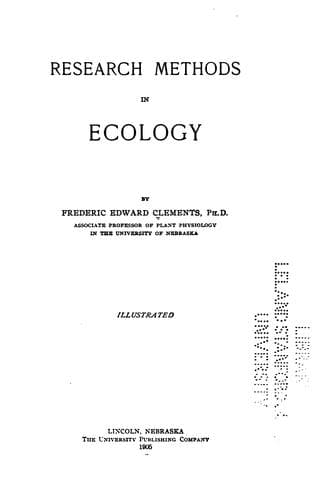
Research methods in ecologyClements, Frederic E. (Frederic Edward)
Science
Research methods in ecology
Clements, Frederic E. (Frederic Edward)
Plant ecology; Plant ecology -- Methodology
=251. Causes.= In considering the causes which produce association, it
is necessary to call in evidence the primary facts of the process in
concrete examples of this principle. These facts are so bound up in the
nature of vegetal organisms that they are the veriest axioms.
Reproduction gives rise immediately to potential, and ultimately, in the
great majority of cases, to actual association. The degree and
permanence of the association are then determined by the immobility of
the individuals as expressed in terms of attachment to each other or to
the stratum, such as sheath, thallus, haustoria, holdfasts, rhizoids,
roots, etc. The range of immobility is very great. In terrestrial
plants, mobility is confined almost entirely to the period when the
individual lies dormant in the seed, spore, or propagative part, which
is alone mobile. In aquatic spermatophytes, the same is true of all
attached forms, while free floating plants such as _Lemna_ are mobile in
a high degree, especially during the vegetative period. Among the algae
and hydrophilous fungi, attached forms are mobile only in the spore or
propagative condition, while the motile forms of the plancton typify the
extreme development of mobility. The immediate result of reproduction in
an immobile species is to produce association of like individuals, while
in the case of a mobile species reproduction may or may not lead
immediately to association. We may lay down the general principle that
immobility tends to maintain the association of the individuals of the
same generation, i. e., the association of like forms, while mobility
tends to separate the similar individuals of one generation and to bring
unlike forms together. With the mobile algae, separation of the members
of each generation is the rule, unless the individuals come to be
associated in a thallus, or are grouped in contact with the substratum.
Flowering plants that are relatively immobile, especially in the seed
state, drop their seeds beneath and about the parent plants, and in
consequence dense association of the new plants is the rule. In very
many cases, however, this primitive tendency is largely or completely
negatived by the presence of special dissemination contrivances, which
are nearly, if not quite, as effective for many terrestrial plants as
the free floating habit is for algae. From this point, the whole
question of mobility belongs to migration, just as the adjustment
between the parent plants and their offspring, or between plants
established and the mobile plants to be established, belongs to
competition.
Public-domain text, read in full here on John Shaqi.
Reviews
Reviews
No reviews yet
Be the first to share your thoughts on this work.
Elsewhere in the archive
Join the Discussion
Join the discussion
Sign in to leave a comment or review.
Sign InorCreate an account