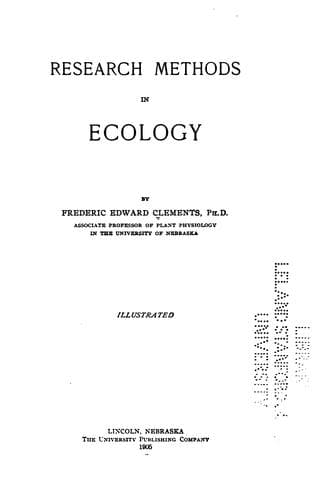
Research methods in ecologyClements, Frederic E. (Frederic Edward)
Science
Research methods in ecology
Clements, Frederic E. (Frederic Edward)
Plant ecology; Plant ecology -- Methodology
The influence of habitat upon germination is of primary importance,
though the manner in which its influence is exerted is by no means as
evident as might be supposed. In the case of seeds sown in the
planthouse, it is almost universally the case that germination is less
than in nature, notwithstanding the fact that temperature and moisture
appear to be optimum. In nature, the seeds of the species may be carried
into a number of different formations, any one or all of which may
present conditions unfavorable to germination. With respect to
probability of germination, habitats are of two sorts: those which are
denuded and those which bear vegetation. It is impossible to lay down
general propositions with respect to either group, since germination
will vary with the character of the invading species, the annual
distribution of heat and moisture in the habitat, etc. In a general way,
however, it may be stated that the chances for germination are greater
in vegetation than in denuded areas, chiefly because the latter are
usually xerophytic. On the other hand, the lack of competition in the
denuded area tends to make ultimate establishment much more certain.
Here, as elsewhere when exact statistical results are desired, the use
of the quadrat, and especially of the permanent quadrat, is necessary to
determine the comparative germination of the invading species in
relation to denudation and vegetation.
=271. Adjustment to the habitat.= The seedling once established by
germination, the probability of its growing and maturing will depend
upon its habitat form, plasticity, and vegetation form. Even though it
may germinate under opposite conditions, a typical hylophyte, such as
Impatiens for example, will not thrive in an open meadow, nor will
characteristic poophytes, such as most grasses, grow in deep shade. In
the same way, xerophytes do not adapt themselves to hydrophytic
habitats, nor hydrophytes to xerophytic conditions. Many mesophytes,
however, possess to a certain degree the ability to adjust themselves to
somewhat xerophytic or hydrophytic situations, while woodland plants
often invade either forest or meadow. This capability for adjustment, i.
e., plasticity, is greatest in intermediate species, those that grow in
habitats not characterized by great excess or deficiency of some factor,
and it is least in forms highly specialized in respect to water-content,
shade, etc. It may then be established as a fundamental rule that ecesis
is determined very largely by the essential physical similarity of the
old and the new habitat, except in the case of plastic forms, which
admit of a wider range of accommodation. The plasticity of a plant is
not necessarily indicated by structural modification, though such
adjustment is usually typical of plastic species, but it may sometimes
arise from a functional adaptation, which for some reason does not
produce concomitant structural changes. The former explains such various
Public-domain text, read in full here on John Shaqi.
Reviews
Reviews
No reviews yet
Be the first to share your thoughts on this work.
Elsewhere in the archive
Join the Discussion
Join the discussion
Sign in to leave a comment or review.
Sign InorCreate an account