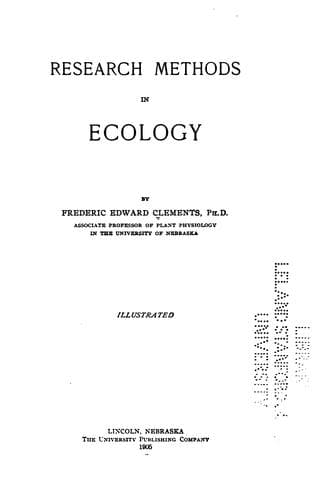
Research methods in ecologyClements, Frederic E. (Frederic Edward)
Science
Research methods in ecology
Clements, Frederic E. (Frederic Edward)
Plant ecology; Plant ecology -- Methodology
=307. Succession in burned areas.= It will suffice merely to point out
that “burns” may arise naturally through lightning, volcanic cinders,
lava flows, etc., but the chances are so slight that these causes may be
ignored. The causes of fires are legion, and as they have little or no
effect upon results, they need not be considered. From their nature,
fires are of little significance in open vegetation, deserts, polar
barrens, alpine fields, etc., since the area of the burn can never be
large. In closed formations, the extent of fires is limited only by the
area of the vegetation, and the effect of wind, rain, and other forces.
Forest fires usually occur during the resting period, except in the case
of coniferous forests. In grassland, the living parts are underground
during autumn and winter, when prairie fires commonly occur. As a
consequence, the repeated annual burning of meadow or prairie does not
result in denudation and subsequent succession. On the contrary, it acts
in part as a stabilizing agent, inasmuch as it injures the typical
vegetation forms of grassland much less than it does the woody invaders.
All formations with perennial parts above ground, viz., thicket, open
woodland, and forest, are seriously injured by fire. A severe general
fire destroys the vegetation completely; a local fire destroys the
formation in restricted areas; while a slight or superficial burn
removes the undergrowth and hastens the disappearance of the weaker
trees. In the latter case, while the primary layer of the forest remains
the same, succession takes place in the herbaceous and shrubby layers.
These successions are peculiar in that they are composed almost wholly
of the proper species of the forest, and that they are very short,
showing only a few poorly defined stages. A local fire initiates a
succession in which the pioneers are derived largely from the original
formation, particularly when the latter encloses the burned area more or
less completely. The constitution of the intermediate and ultimate
stages will depend in a larger degree still upon the size and position
of the burn. When a particular formation is destroyed wholly or in large
part, the first stages of the new vegetation are made up by invaders
from the adjacent formations. In the most perfect types of succession,
this dissimilarity between the new and the old vegetation continues to
the last stage, in which the reappearance of the facies precedes that of
the subordinate layers. In many forest successions, however, the general
physical similarity of the ultimate stages permits the early
reappearance of the herbaceous and shrubby species, and the final stages
affect the facies alone. Successions in burned areas operate usually
within the water-content groups. The reconstruction of a mesophytic
forest takes place by means of mesophytes; of the rarer xerophytic and
hydrophytic forests, through xerophytes and hydrophytes respectively.
Public-domain text, read in full here on John Shaqi.
Reviews
Reviews
No reviews yet
Be the first to share your thoughts on this work.
Elsewhere in the archive
Join the Discussion
Join the discussion
Sign in to leave a comment or review.
Sign InorCreate an account