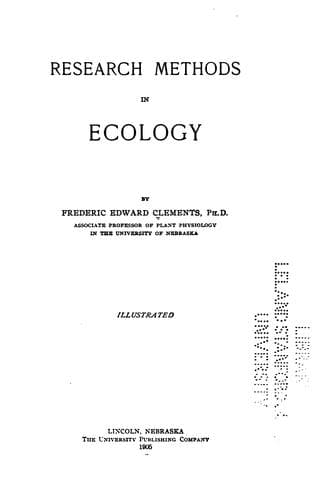
Research methods in ecologyClements, Frederic E. (Frederic Edward)
Science
Research methods in ecology
Clements, Frederic E. (Frederic Edward)
Plant ecology; Plant ecology -- Methodology
outposts of a new flora are rapidly advancing, as in wide mesophytic
valleys that run down into or traverse plains. Here the change is often
sudden, and grass and desert formations are replaced by thickets and
forests, resulting in abrupt succession. Species guilds are typical
examples of this. More rarely, a stage foreign to the succession will be
interpolated, replacing a normal stage, or slipping in between two such,
though finally disappearing before the next regular formation. This may
be distinguished as interpolated succession.
The apparent terminus of all stabilization is the forest, on account of
the thoroughness with which it controls the habitat. A close examination
of vegetation, however, will show that its stable terms are dependent in
the first degree upon the character of the region in which the formation
is indigenous. It is obviously impossible that successions in desert
lands, in polar barrens, or upon alpine stretches should terminate in
forest stages. In these, grassland must be the ultimate condition,
except in those extreme habitats, alpine and polar, where mosses and
lichens represent the highest type of existing vegetation. Forests are
ultimate for all successions in habitats belonging to a region generally
wooded, while grassland represents the terminus of prairie and plains
successions as well as of many arctic-alpine ones.
_CAUSES AND REACTIONS_
=315.= The initial cause of a succession must be sought in a physical
change in the habitat; its continuance depends upon the reaction which
each stage of vegetation exerts upon the physical factors which
constitute the habitat. A single exception to this is found in anomalous
successions, where the change of formation often hinges upon the
appearance of remote or foreign disseminules. The causes which initiate
successions have already been considered; they may be summarized as
follows: (1) weathering, (2) erosion, (3) elevation, (4) subsidence, (5)
climatic changes, (6) artificial changes. The effect of succeeding
stages of vegetation upon a new or denuded habitat usually finds
expression in a change of the habitat with respect to a particular
factor, and in a definite direction. Often, there is a primary reaction,
and one or more secondary ones, which are corollaries of it. Rarely,
there are two or more coordinate reactions. The general ways in which
vegetation reacts upon the habitat are the following: (1) by preventing
weathering, (2) by binding aeolian soils, (3) by reducing run-off and
preventing erosion, (4) by filling with silt and plant remains, (5) by
enriching the soil, (6) by exhausting the soil, (7) by accumulating
humus, (8) by modifying atmospheric factors. The direction of the
movement of a succession is the immediate result of its reaction. From
the fundamental nature of vegetation, it must be expressed in terms of
water-content. The reaction is often so great that the habitat undergoes
Public-domain text, read in full here on John Shaqi.
Reviews
Reviews
No reviews yet
Be the first to share your thoughts on this work.
Elsewhere in the archive
Join the Discussion
Join the discussion
Sign in to leave a comment or review.
Sign InorCreate an account