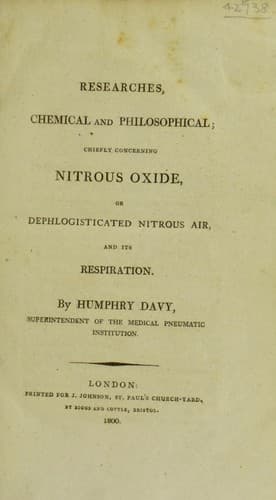
Researches Chemical and Philosophical; Chiefly concerning nitrous oxide: or dephlogisticated nitrous air and its respirationDavy, Humphry, Sir
Science
Researches Chemical and Philosophical; Chiefly concerning nitrous oxide: or dephlogisticated nitrous air and its respiration
Davy, Humphry, Sir
Nitrous oxide
_c._ A kitten of about two months old, was introduced into a jar of
nitrous oxide, at the same time that another of the same breed was
plunged under a jar of water. They both struggled very much. The
animal in the nitrous oxide fell senseless before that under water had
ceased to struggle, and to throw out air from its lungs. In two minutes
and three quarters, the animal under water was quite dead: it was taken
out and exposed to heat and air, but did not shew the slightest signs
of life. At the end of three minutes and half, the animal in nitrous
oxide began to gasp, breathing very slowly; at four minutes and three
quarters it was yet alive; at the end of five minutes and quarter it
appeared perfectly dead. It was taken out, and did not recover.
From these experiments it was evident, that animals lived at least
twice as long in nitrous oxide as in hydrogene or water. Consequently
from this circumstance alone, there was every reason to suppose that
their death in nitrous oxide could not depend on the simple privation
of atmospheric air; but that it was owing to some peculiar changes
effected in the blood by the gas.
IV. _Of the changes effected in the Organisation of warm-blooded
Animals, by the respiration of Nitrous Oxide._
The external appearance of animals that have been destroyed in nitrous
oxide, is very little different from that of those killed by privation
of atmospheric air. The fauces and tongue appear of a dark red, and the
eyes are dull, and a little protruded. Their internal organs, however,
exhibit a very peculiar change. The lungs are pale brown red, and
covered here and there with purple spots; the liver is of a very bright
red, and the muscular fibre in general dark. Both the auricles and
ventricles of the heart are filled with blood. The auricles contract
for minutes after the death of the animal. The blood in the left
ventricle, and the aorta, is of a tinge between purple and red, whilst
that in the right ventricle is of a dark color, rather more purple
than the venous blood. But these appearances, and their causes, will
be better understood after the following comparative observations are
read.
_a._ Of two similar rabbits, about eight months old, one A, was killed
by exposure for near six minutes to nitrous oxide, the other, B, was
destroyed by a blow on the head.
Public-domain text, read in full here on John Shaqi.
Reviews
Reviews
No reviews yet
Be the first to share your thoughts on this work.
Elsewhere in the archive
Join the Discussion
Join the discussion
Sign in to leave a comment or review.
Sign InorCreate an account