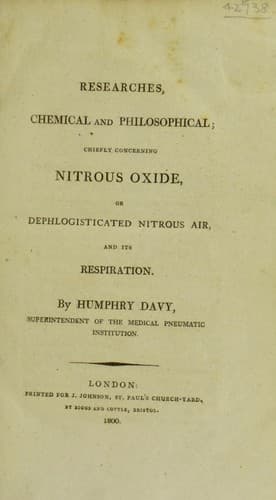
Researches Chemical and Philosophical; Chiefly concerning nitrous oxide: or dephlogisticated nitrous air and its respirationDavy, Humphry, Sir
Science
Researches Chemical and Philosophical; Chiefly concerning nitrous oxide: or dephlogisticated nitrous air and its respiration
Davy, Humphry, Sir
Nitrous oxide
I introduced into a silk bag four quarts of well washed carbonic acid
produced from carbonate of ammoniac[212] by heat, and after a compleat
voluntary exhaustion of my lungs, attempted to inspire it. It tasted
strongly acid in the mouth and fauces, and produced a sense of burning
at the top of the uvula. In vain I made powerful voluntary efforts
to draw it into the windpipe; at the moment that the epiglottis was
raised a little, a painful stimulation was induced, so as to close
it spasmodically on the glottis; and thus in repeated trials I was
prevented from taking a single particle of carbonic acid into my lungs.
[212] Carbonic acid is produced in this way in a high state of purity,
and with great readiness.
I tried to breathe a mixture of two quarts of common air and three of
carbonic acid, without success; it stimulated the epiglottis nearly in
the same manner as pure carbonic acid, and was perfectly non-respirable.
I found that a mixture of three quarts of carbonic acid with seven of
common air was respirable, I breathed it for near a minute. At the
time, it produced a slight degree of giddiness, and an inclination to
sleep. These effects however, very rapidly disappeared after I had
ceased to breathe,[213] and no other affections followed.
[213] Carbonic acid possesses no action on arterial blood. Hence
perhaps, its slight effects when breathed mingled with large quantities
of common air. Its effects are very marked upon venous blood! If
it were thrown forcibly into the lungs of animals, the momentary
application of it to the pulmonary venous blood would probably destroy
life.
During the course of experiments on nitrous oxide, I several times
breathed Oxygene procured from manganese by heat, for from three to
five minutes.
In respiring eight or ten quarts; for the first two or three minutes
I could perceive no effects. Towards the end, even when I breathed
very slowly, my respiration became oppressed, and I felt a sensation
analogous to that produced by the want of fresh air; though but little
of the oxygene had been consumed.
In one experiment when I breathed from and into a bag containing 20
quarts of oxygene for near six minutes; Dr. Kinglake felt my pulse,
and found it not altered in velocity, but rather harder than before. I
perceived no effects but those of oppression on the chest[214].
[214] In a conversation with Mr. Watt, relating to the powers of gases,
that excellent philosopher told me he had for some time entertained
a suspicion, that the effects attributed to oxygene produced from
manganese by heat, in some measure depended upon nitrous acid suspended
in the gas, formed during ignition by the union of some of the oxygene
of the manganese with nitrogene likewise condensed in it.
Public-domain text, read in full here on John Shaqi.
Reviews
Reviews
No reviews yet
Be the first to share your thoughts on this work.
Elsewhere in the archive
Join the Discussion
Join the discussion
Sign in to leave a comment or review.
Sign InorCreate an account