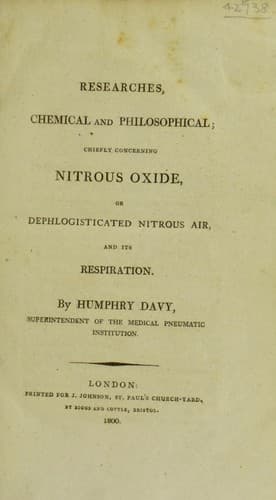
Researches Chemical and Philosophical; Chiefly concerning nitrous oxide: or dephlogisticated nitrous air and its respirationDavy, Humphry, Sir
Science
Researches Chemical and Philosophical; Chiefly concerning nitrous oxide: or dephlogisticated nitrous air and its respiration
Davy, Humphry, Sir
Nitrous oxide
106 cubic inches, of similar composition, weighed in like manner,
gave at the same temperature and pressure nearly 52,25 grains; and in
another experiment, when the thermometer was 41°, 53 grains.
So that accounting for the small quantity of common air contained in
the gases weighed, we may conclude, that 100 cubic inches of pure
nitrous oxide weigh 50,1 grains at temperature 50°, and atmospheric
pressure 30,7.
I was a little surprised at this great specific gravity, particularly
as I had expected, from Dr. Priestley’s observations, to find it less
heavy than atmospherical air. This philosopher supposed, from some
appearances produced by the mixture of it with aëriform ammoniac, that
it was even of less specific gravity than that gas.[81]
[81] Experiments and Observations, vol. 2, pag. 89. Last Edition.
V. _Analysis of Nitrous Oxide._
The nitrous oxide may be analised, either by charcoal or hydrogene;
during the combustion of other bodies in it, small portions of nitrous
acid are generally formed, as will be fully explained hereafter.
The gas that I employed was generated from compact nitrate of ammoniac,
and was in its highest state of purity, as it left a residuum of ¹/₃₈
only, when absorbed by boiled water.
10 cubic inches of it were inserted into a jar graduated to,1 cubic
inches, containing dry mercury. Through this mercury a piece of
charcoal which had been deprived of its hydrogene by long exposure
to heat, weighing about a grain, was introduced, while yet warm. No
perceptible absorption of the gas took place.[82]
[82] A minute quantity, however, must have been absorbed, and given out
again when the charcoal was heated.
Thermometer being 46°, the focus of a lens was thrown on the charcoal,
which instantly took fire, and burnt vividly for about a minute, the
gas being increased in volume. After the vivid combustion had ceased,
the focus was again thrown on the charcoal; it continued to burn for
near ten minutes, when the process stopped.
The gas, when the original pressure and temperature were restored,
filled a space equal to 12,5 cubic inches.
On introducing to it a small quantity of strong solution of
ammoniac[83], white vapor was instantly perceived, and after a short
time the reduction was to about 10,1 cubic inches; so that apparently,
2,4 cubic inches of carbonic acid had been formed. The 10,1 cubic
inches of gas remaining were exposed to water which had been long in
ebullition, and which was introduced whilst boiling, under mercury.
After the absorption of the nitrous oxide by the water, the gas
remaining was equal to 5,3.
[83] Strong solution of ammoniac has no attraction for nitrous oxide.
But on combining a cubic inch of pure nitrous oxide with some of the
same water, which had been received under mercury in a separate vessel,
nearly ¹/₂₂ remained. Consequently we may conclude, that 5,1 of a gas
unabsorbable by water, was produced in the combustion.
Public-domain text, read in full here on John Shaqi.
Reviews
Reviews
No reviews yet
Be the first to share your thoughts on this work.
Join the Discussion
Join the discussion
Sign in to leave a comment or review.
Sign InorCreate an account