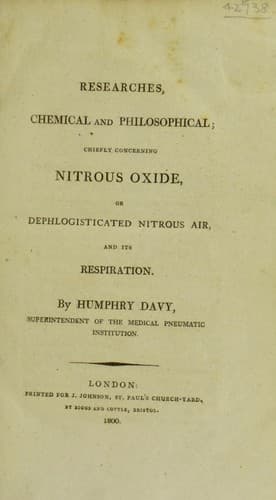
Researches Chemical and Philosophical; Chiefly concerning nitrous oxide: or dephlogisticated nitrous air and its respiration — John Shaqi
Researches Chemical and Philosophical; Chiefly concerning nitrous oxide: or dephlogisticated nitrous air and its respirationDavy, Humphry, Sir
Science
Researches Chemical and Philosophical; Chiefly concerning nitrous oxide: or dephlogisticated nitrous air and its respiration
Davy, Humphry, Sir
Nitrous oxide
To ascertain this point with precision, I distilled a small quantity
of the same kind of water, which had been near an hour in ebullition,
into a graduated cylinder containing mercury. To this I introduced
about one third of its bulk, i. e. 12 measures of nitrous oxide, which
had been carefully generated in the mercurial apparatus. After the
absorption, a small globule of gas only remained, which could hardly
have equalled one fourth of a measure. On admitting to this globule a
minute quantity of nitrous gas, an evident diminution took place.
Though this experiment proved that in proportion as the water was free
from air, the residuum was less, and though there was no reason to
suppose that the ebullition and distillation had freed the water from
the whole of the air it had held in solution, still I considered a
decisive experiment wanting to determine whether nitrous oxide was the
only gas produced in the slow decomposition of nitrate of ammoniac, or
whether a minute quantity of oxygene was not likewise evolved.
I received the middle part of the product of a decomposition of nitrate
of ammoniac, under a cylinder filled with dry mercury, and introduced
to it some strong solution of ammoniac. After the white cloud produced
by the combination of the ammoniacal vapor with the nitric acid
suspended in the nitrous oxide, had been completely precipitated, I
introduced a small quantity of nitrous gas. No white vapor was produced.
Now if any gas combinable with nitrous gas had existed in the cylinder,
the quantity of nitrous acid produced, however small, would have
been rendered perceptible by the ammoniacal fumes; for when a minute
globule of common air was admitted into the cylinder, white clouds were
instantly perceptible.
It seems therefore reasonable to conclude,
1. That the residual gas of nitrous oxide, is air previously contained
in the water, (which in no case can be perfectly freed from it by
ebullition), and liberated by the stronger attraction of that fluid for
nitrous oxide.
2. That nitrate of ammoniac, at temperatures below 440°, is
decompounded into pure nitrous oxide, and fluid.
3. That in ascertaining the purity of nitrous oxide from its absorption
by water, corrections ought to be made for the quantity of gas
dispelled from the water. This quantity in common water distilled
under mercury being about ¹/₅₀; in water simply boiled, and used when
hot, about ¹/₃₆; and in common spring water, ¹/₁₂.
IV. _Specific gravity of Nitrous Oxide._
To understand accurately the changes taking place during the
decomposition of nitrate of ammoniac, we must be acquainted with the
specific gravity and composition of nitrous oxide.
90 cubic inches of it, containing about ¹/₃₅ common air, introduced
from the mercurial airholder into an exhausted globe, increased it in
weight 44,75 grains; thermometer being 51°, and atmospheric pressure
30,7.
Public-domain text, read in full here on John Shaqi.
Reviews
Reviews
No reviews yet
Be the first to share your thoughts on this work.
Join the Discussion
Join the discussion
Sign in to leave a comment or review.
Sign InorCreate an account