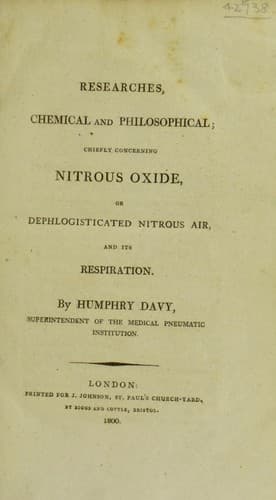
Researches Chemical and Philosophical; Chiefly concerning nitrous oxide: or dephlogisticated nitrous air and its respirationDavy, Humphry, Sir
Science
Researches Chemical and Philosophical; Chiefly concerning nitrous oxide: or dephlogisticated nitrous air and its respiration
Davy, Humphry, Sir
Nitrous oxide
This gas extinguished flame, gave no diminution with oxygene, and the
slightest possible with nitrous gas. When an electric spark was passed
through it, mingled with oxygene; no inflammation, or _perceptible_
diminution took place.[84] We may consequently conclude that it was
nitrogene, mingled with a minute portion of common air, expelled from
the water.
[84] The gas was examined by those tests in order to prove that no
water had been decomposed.
The charcoal was diminished in bulk to one half nearly, but the loss of
weight could not be ascertained, as its pores were filled with mercury.
Now 5 cubic inches of nitrous oxide were absorbed by the water,
consequently 5 were decompounded by the charcoal; and these produced
5,1 cubic inches of nitrogene; and by giving their oxygene to the
charcoal, apparently 2,4 of carbonic acid.
But 5 cubic inches of nitrous oxide weigh 2,5 grains, and 5,1 cubic
inches of nitrogene 1,55; then 2,5-1,55 =,95.
So that reasoning from the relative specific gravities of nitrogene and
nitrous oxide, 2,5 grains of the last are composed of 1,55 nitrogene,
and,95 oxygene.
But from many experiments made on the specific gravity of carbonic
acid, in August, 1799, I concluded that 100 cubic inches of it weighed
47,5 grains, thermometer being 60,1°, and barometer 29,5. Consequently,
making the necessary corrections, 2,4 cubic inches of it weigh
1,14 grains; and on Lavoisier’s and Guyton’s[85] estimation of its
composition, these 1,13 grains contain 8,2 of oxygene.
[85] See the curious paper of this excellent philosopher, on the
combustion of the diamond, in which he proves that charcoal is, in
fact, oxide of diamond. Annales de Chimie, xxxi.
So that, drawing conclusions from the quantity of carbonic acid formed
in this experiment, 2,5 grains of nitrous oxide will be composed of,82
oxygene, and 1,68 nitrogene.
The difference between these estimations is considerable, and yet not
more than might have been expected, if we consider the probable sources
of error in the experiment.
1. It is likely that variable minute quantities of hydrogene remain
combined with charcoal, even after it has been long exposed to a red
heat.
2. It is probable that the nitrogene and carbonic acid produced were
capable of dissolving more water than that held in solution by the
nitrous oxide; and if so, they were more condensed than if saturated
with moisture, and hence the quantity of carbonic acid under-rated.
We may consequently suppose the estimation founded on the quantity of
nitrogene evolved, most correct; and making a small allowance for the
difference, conclude, that 100 grains of nitrous oxide are composed of
about 37 oxygene, and 63 nitrogene; existing in a much more condensed
state than when in their simple forms.
The tolerable accuracy of this statement will be hereafter demonstrated
by a number of experiments on the combustion of different bodies in
nitrous oxide, detailed in Research II.
Public-domain text, read in full here on John Shaqi.
Reviews
Reviews
No reviews yet
Be the first to share your thoughts on this work.
Join the Discussion
Join the discussion
Sign in to leave a comment or review.
Sign InorCreate an account