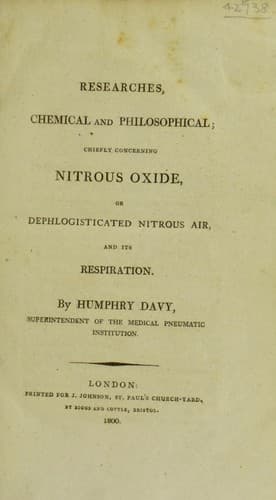
Researches Chemical and Philosophical; Chiefly concerning nitrous oxide: or dephlogisticated nitrous air and its respirationDavy, Humphry, Sir
Science
Researches Chemical and Philosophical; Chiefly concerning nitrous oxide: or dephlogisticated nitrous air and its respiration
Davy, Humphry, Sir
Nitrous oxide
VI. _Minute examination of the decomposition of Nitrate of Ammoniac._
Into a retort weighing 413,75 grains, and of the capacity of 7,5
cubic inches, 100 grains of pulverised compact nitrate of ammoniac
were introduced. To the neck of this retort was adapted a recipient,
weighing 711 grains, tubulated for the purpose of communicating with
the mercurial airholder, and of the capacity of 8,3 cubic inches.
Temperature being 50° and atmospheric pressure 30,6, the recipient
was inserted into a vessel of cold water, and made to communicate
with the airholder. The heat of a spirit lamp was then slowly applied
to the retort: the salt quickly began to decompose, and to liquify.
The temperature was so regulated, as to keep up an equable and slow
decomposition.
During this decomposition, no luminous appearance was perceived in the
retort; the gas that came into the airholder was very little clouded,
and much water condensed in the receiver.
After the process was finished, the communication between the mercurial
airholder and the recipient was preserved till the common temperature
was restored to the retort.
The volume of the gas in the cylinder was 85,5 cubic inches. The
absolute quantity of nitrous oxide in those 85,5 cubic inches, it was
difficult to ascertain with great nicety, on account of the common air
previously contained in the vessels.
45 measures of it, exposed to well boiled water, diminished by
agitation to 8 measures. So that reasoning from the quantity of air,
which should have been expelled from the water by the nitrous oxide, we
may conclude that the 85,5 cubic inches were nearly pure.
The retort now weighed 419,25 grains, consequently 5,5 grains of salt
remained in it. This salt was chiefly collected about the lower part
of the neck, and contained rather more water than the compact nitrate,
as in some places it was crystalised.
The recipient with the fluid it contained, weighed 759 grains. It had
consequently gained in weight 48 grains.
Now the 85,5 cubic inches of nitrous oxide produced, weigh about 42,5
grains; and this added to 48 and 5,5, = 96 grains; so that about 4
grains of salt and fluid were lost, probably by being carried over and
deposited by the gas.[86]
[86] This was actually the case; for on examining the conducting tube
the day after the experiment, some minute crystals of prismatic nitrate
of ammoniac were perceived in it.
As much of the fluid as could be taken out of the recipient, weighed
46 grains, and held in solution much nitrate of ammoniac with
superabundance of acid. This acid required for its saturation, 3⅛ of
carbonate of ammoniac (containing, as well as I could guess), about 20
per cent alkali.
Public-domain text, read in full here on John Shaqi.
Reviews
Reviews
No reviews yet
Be the first to share your thoughts on this work.
Join the Discussion
Join the discussion
Sign in to leave a comment or review.
Sign InorCreate an account