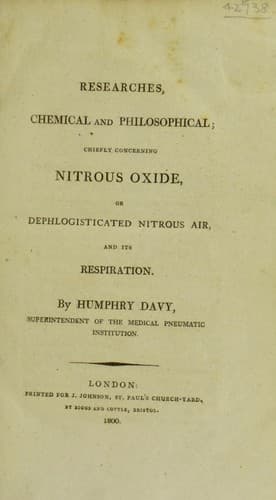
Researches Chemical and Philosophical; Chiefly concerning nitrous oxide: or dephlogisticated nitrous air and its respirationDavy, Humphry, Sir
Science
Researches Chemical and Philosophical; Chiefly concerning nitrous oxide: or dephlogisticated nitrous air and its respiration
Davy, Humphry, Sir
Nitrous oxide
The analysis of nitrous gas by charcoal, as affording data for
determining immediately the quantities of oxygene and nitrogene,
ought to be considered as most accurate; and correcting it by mean
calculations derived from the decomposition of nitrous gas by
pyrophorus and hydrogene, and its conversion into nitrous oxide, a
process to be described hereafter, we may conclude, that 100 grains
of nitrous gas are composed of 55,95 oxygene, and 44,05 nitrogene; or
taking away decimals, of 56 oxygene, and 44 nitrogene.
This estimation will agree very well with the mean proportions that
would be given from Dr. Priestley’s experiments on the decomposition
of nitrous gas by iron; but as he never ascertained the purity of his
nitrous gas,[106] and probably employed different kinds in different
experiments, it is impossible to fix on any one, from which accurate
conclusions can be drawn.
Lavoisier’s estimation of the quantities of oxygene and nitrogene
entering into the composition of nitrous gas, has been generally
adopted. He supposes 64 parts of nitrous gas to be composed of 43½ of
oxygene, and 20½ of nitrogene.[107]
[106] Elements English Trans. edit. i. pag. 216.
[107] Experiments and Observations, Vol. II. pag. 40, 2d. Ed.
The difference between this account and mine is very great indeed;
but I have already, in Division 1st, pointed out sources of error in
the experiments of this great man, on the decomposition of nitre by
charcoal; which experiments were fundamental, both to his accounts of
the constitution of nitrous acid, and nitrous gas.
V. _Of the absorption of Nitrous Gas by Water._
Amongst the properties of nitrous gas noticed by its great discoverer,
is that of absorbability by water.
In exposing nitrous air to distilled water, Dr. Priestley found a
diminution of the volume of gas, nearly equal to one tenth of the bulk
of the water; and by boiling the water thus impregnated, he procured
again a certain portion of the nitrous gas.
Humbolt, in his paper on eudiometry, mentions the diminution of
nitrous gas by water. This diminution, he supposes to arise from the
decomposition of a portion of the nitrous gas, by the water, and the
consequent formation of nitrate of ammoniac.[108]
Public-domain text, read in full here on John Shaqi.
Reviews
Reviews
No reviews yet
Be the first to share your thoughts on this work.
Elsewhere in the archive
Join the Discussion
Join the discussion
Sign in to leave a comment or review.
Sign InorCreate an account