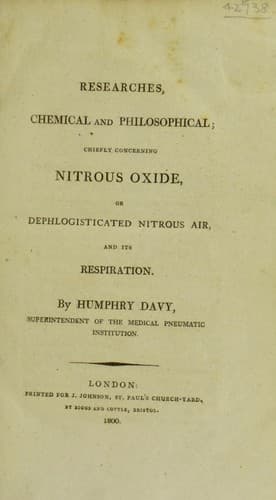
Researches Chemical and Philosophical; Chiefly concerning nitrous oxide: or dephlogisticated nitrous air and its respirationDavy, Humphry, Sir
Science
Researches Chemical and Philosophical; Chiefly concerning nitrous oxide: or dephlogisticated nitrous air and its respiration
Davy, Humphry, Sir
Nitrous oxide
I attempted to analise nitrous gas, by introducing into a known
quantity of it, confined by mercury, phosphorus, in a vessel containing
a minute quantity of oxygene.[105] The phosphorus was inflamed with
an ignited iron wire, by which, at the moment of the combustion, the
vessel containing it was raised from the mercury into the nitrous gas.
But after making in this way, five of six unsuccessful experiments, I
desisted. When the communication between the vessels was made before
the oxygene was nearly combined with the phosphorus, nitrous acid
was formed, which instantly destroyed the combustion; when, on the
contrary, the phosphorus was suffered to consume almost the whole
of the oxygene, it was not sufficiently ignited when introduced, to
decompose the nitrous gas.
[105] This mode of inflaming bodies in gases, not capable of supporting
combustion at low temperatures, will be particularly described
hereafter.
In one experiment, indeed, the phosphorus burnt for a moment in the
nitrous gas; the diminution however was slight, and not more than ¼ of
it was decomposed.
Sulphur, introduced in a state of vivid inflammation, into nitrous gas,
was instantly extinguished.
I passed a strong electric shock through equal parts of hydrogene
and nitrous gas, confined by mercury in a detonating tube; but no
inflammation, or perceptible diminution, was produced.
19,2 grain measures of hydrogene were fired by the electric shock,
with 10 of nitrous oxide, and 6 of nitrous gas; the diminution was
to 17; and pale green sulphate of iron admitted to the residuum, was
not discolored. Consequently the nitrous gas was decomposed by the
hydrogene, and as will be hereafter more clearly understood, nearly as
much nitrogene furnished by it, as would have been produced from half
the quantity of nitrous oxide.
Suspecting that phosphorated hydrogene might inflame with nitrous
gas, I passed the electric spark through 1 measure of phosphorated
hydrogene, and 4 of nitrous gas; but no diminution was perceptible. I
likewise passed the electric spark through 1 of nitrous gas, with 2 of
phosphorated hydrogene, without inflammation.
Perhaps if I had tried many other different proportions of the gases, I
should have at last discovered one, in which they would have inflamed;
for, as will be seen hereafter, nitrous oxide cannot be decomposed by
the compound combustible gases, except definite quantities are employed.
From Dr. Priestley’s experiments on iron and pyrophorus, and from the
experiments I have detailed, on charcoal, phosphorus, and hydrogene,
it appears that at certain temperatures, nitrous gas is decomposable
by most of the combustible bodies: even the extinction of sulphur, when
introduced into it in a state of inflammation, depends perhaps, on the
smaller quantity of heat produced by the combustion of this body, than
that of most others.
Public-domain text, read in full here on John Shaqi.
Reviews
Reviews
No reviews yet
Be the first to share your thoughts on this work.
Elsewhere in the archive
Join the Discussion
Join the discussion
Sign in to leave a comment or review.
Sign InorCreate an account