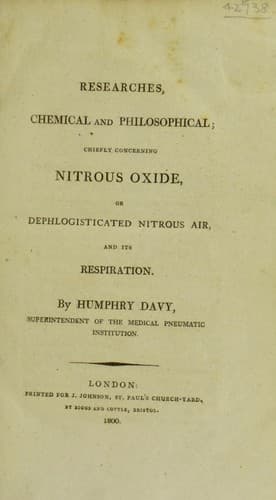
Researches Chemical and Philosophical; Chiefly concerning nitrous oxide: or dephlogisticated nitrous air and its respirationDavy, Humphry, Sir
Science
Researches Chemical and Philosophical; Chiefly concerning nitrous oxide: or dephlogisticated nitrous air and its respiration
Davy, Humphry, Sir
Nitrous oxide
The remaining gas was introduced into a tube graduated to,02 cubic
inches. It measured ¹⁴/₅₀; hence ¹¹/₅₀ had been absorbed.
Consequently, 100 cubic inches of pure water are capable of absorbing
11,8 of nitrous gas. In the water thus impregnated with nitrous gas I
could distinguish no peculiar taste;[110] it did not at all alter the
color of blue cabbage juice.
[110] Dr. Priestley found distilled water, saturated with nitrous air,
to acquire an astringent taste and pungent smell. In some unboiled
impregnated pump water, I once thought that I perceived a subacid
taste; but it was extremely slight, and probably owing to nitrous acid
formed by the union of the oxygene of the common air in the water, with
some of the nitrous gas.
_b._ To determine if the absorption of nitrous gas was owing, to a
decomposition of it by the water, as Humbolt has supposed, or to a
simple solution; I procured some nitrous gas from nitrous acid and
mercury, containing about one seventieth nitrogene. ,5 cubic inches
of it, mingled with ,25, of oxygene, from sulphuric acid and manganese
left a residuum of,03. 5 cubic inches more were introduced to 3 of
water, procured in the same manner as in the last experiment, in the
same cylinder. After the diminution was complete, the cylinder was
transferred in a small vessel containing mercury, into a water bath,
and nearly covered by the water.
As the bath was heated, small globules of gas were given out from the
impregnated water, and when it began to boil, the production of gas was
still more rapid. After an hour’s ebullition, the volume of heated gas
was equal to 1,4 cubic inches nearly.
The cylinder was now taken out of the bath, and quickly rendered cool
by being placed in a water apparatus. At the common temperature the gas
occupied, as nearly as possible, the space of,5 cubic inches: these,5
mingled with,25 of oxygene, of the same kind as that employed before,
left a residuum nearly equal to,03.
From this experiment, which was repeated with nearly the same results,
it is evident,
1. That nitrous gas is not decomposable by pure water.
2. That the diminution of volume of nitrous gas placed
in contact with water, is owing to a simple solution
of it in that fluid.
3. That at the temperature of 212°, nitrous gas is
incapable of remaining in combination with water.
Public-domain text, read in full here on John Shaqi.
Reviews
Reviews
No reviews yet
Be the first to share your thoughts on this work.
Elsewhere in the archive
Join the Discussion
Join the discussion
Sign in to leave a comment or review.
Sign InorCreate an account