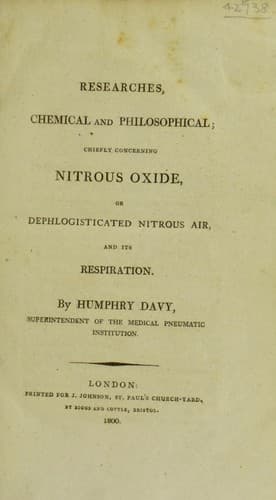
Researches Chemical and Philosophical; Chiefly concerning nitrous oxide: or dephlogisticated nitrous air and its respirationDavy, Humphry, Sir
Science
Researches Chemical and Philosophical; Chiefly concerning nitrous oxide: or dephlogisticated nitrous air and its respiration
Davy, Humphry, Sir
Nitrous oxide
Humbolt’s opinion relating to the decomposition of nitrous gas by
water, is founded upon the disengagement of vapor from distilled water
impregnated with nitrous gas, by means of lime, which became white in
the proximity of the muriatic acid. But this is a very imperfect, and
fallacious test, of the presence of ammoniac. I have this day, April
2, 1800, heated 4 cubic inches of distilled water, impregnated with
nitrous gas, with caustic lime; the vapor certainly became a little
whiter when held over a vessel containing muriatic acid; but the vapor
of distilled water produced precisely the same appearance,[111] which
was owing, most likely, to the combination of the acid with the
aqueous vapor. Indeed, when I added a particle of nitrate of ammoniac,
which might have equalled one twentieth of a grain, to the lime and
impregnated water, the increased whiteness of the vapor was but barely
perceptible, though this quantity of nitrate of ammoniac is much more
considerable than that which could have been formed, even supposing the
nitrous gas decomposed.
[111] As carbonic acid and ammoniac are both products of animalisation,
is it not probable that our common waters particularly those in, and
near towns and cities, contain carbonate of ammoniac? If so, this
salt will always exist in them after distillation. In the experiments
on carbonate of ammoniac, to which I have often alluded, I found, in
distilling a solution of this salt in water, that before half of the
water had passed into the recipient, the carbonate of ammoniac had
sublimed; so that the distilled solution was much stronger than before,
whilst the water remaining in the retort was tasteless. Will this
supposition at all explain Humbolt’s mistake?
VI. _Of the absorption of Nitrous Gas by Water of different kinds._
In agitating nitrous gas over spring water, the diminution rarely
amounts to more than one thirtieth, the volume of water being taken as
unity. I at first suspected that this great differcnce in the quantity
of gas absorbed by spring water, and pure water, depended on carbonic
acid contained in the last, diminishing the attraction of it for
nitrous gas: but by long boiling a quantity of spring water confined
by mercury, I obtained from it about one twentieth of its bulk of air,
which gave nearly the same diminution with nitrous gas, as atmospheric
air.
This fact induced me to refer the difference of diminution to the
decomposition of the atmospheric air held in solution by the water,
the oxygene of which I supposed to be converted into nitric acid, by
the nitrous gas, whilst the nitrogene was liberated; and hence the
increased residuum.
_a._ I exposed to pure water, that is, water procured by distillation
under mercury, nitrous gas, containing a known quantity of nitrogene.
After the absorption was complete, I found the same quantity of
nitrogene in the residuum, as was contained in a volume of gas equal to
the whole quantity employed.
Public-domain text, read in full here on John Shaqi.
Reviews
Reviews
No reviews yet
Be the first to share your thoughts on this work.
Elsewhere in the archive
Join the Discussion
Join the discussion
Sign in to leave a comment or review.
Sign InorCreate an account