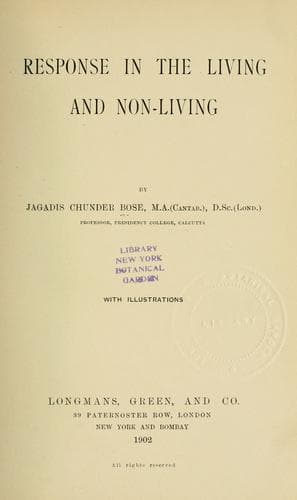
Response in the Living and Non-LivingBose, Jagadis Chandra
Science
Response in the Living and Non-Living
Bose, Jagadis Chandra
Electrophysiology; Fatigue; Irritability
Thus living response in all its diverse manifestations is found to be
only a repetition of responses seen in the inorganic. There is in it no
element of mystery or caprice, such as we must admit to be applied in
the assumption of a hypermechanical vital force, acting in contradiction
or defiance of those physical laws that govern the world of matter.
Nowhere in the entire range of these response-phenomena--inclusive
as that is of metals, plants, and animals--do we detect any breach of
continuity. In the study of processes apparently so complex as those of
irritability, we must, of course, expect to be confronted with many
difficulties. But if these are to be overcome, they, like others, must
be faced, and their investigation patiently pursued, without the
postulation of special forces whose convenient property it is to meet
all emergencies in virtue of their vagueness. If, at least, we are ever
to understand the intricate mechanism of the animal machine, it will be
granted that we must cease to evade the problems it presents by the use
of mere phrases which really explain nothing.
We have seen that amongst the phenomena of response, there is no
necessity for the assumption of vital force. They are, on the contrary,
physico-chemical phenomena, susceptible of a physical inquiry as
definite as any other in inorganic regions.
Physiologists have taught us to read in the response-curves a history of
the influence of various external agencies and conditions on the
phenomenon of life. By these means we are able to trace the gradual
diminution of responsiveness by fatigue, by extremes of heat and cold,
its exaltation by stimulants, the arrest of the life-process by poison.
The investigations which have just been described may possibly carry us
one step further, proving to us that these things are determined, not by
the play of an unknowable and arbitrary vital force, but by the working
of laws that know no change, acting equally and uniformly throughout the
organic and the inorganic worlds.
FOOTNOTES:
[21] Verworn, _General Physiology_, p. 18.
INDEX
Action current
in metal, 88
in nerve, 8
in plant, 19
After-images and their revival, 177
After-oscillation in photo-sensitive cell, 159, 163
Anaesthetics, effect on response
in nerve, 72
in plant, 30, 73, 74, 75
Annealing, effect on response in metal, 101, 138
Binocular alternation of vision, 175
Block method, advantages of, 28, 77
for obtaining response
in metal, 82
in plant, 28
Chloral, effect on plant response, 75
Chloroform, effect on
nerve response, 72
plant response, 74
Compensator, 22
Current of injury in nerve, 7
Curves, characteristics of response, 3
Death-point, determination of, in plants, 61, 63
Depressants, effect on inorganic response, 142
Depression, response by relative, 87
Dewar on retinal current, 149
Public-domain text, read in full here on John Shaqi.
Reviews
Reviews
No reviews yet
Be the first to share your thoughts on this work.
Elsewhere in the archive
Join the Discussion
Join the discussion
Sign in to leave a comment or review.
Sign InorCreate an account