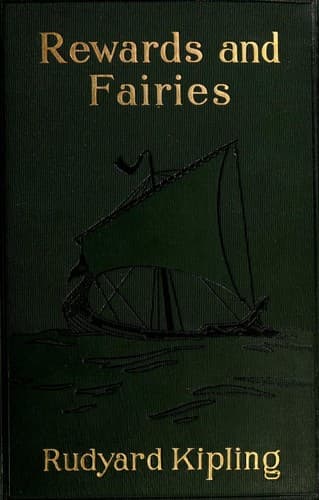
Fairies -- Juvenile fiction; Fantasy literature; Short stories, English; Siblings -- Juvenile fiction
‘When the plague is so hot in a village that the neighbours shut the
roads against ‘em, people set a hollowed stone, pot, or pan, where such
as would purchase victual from outside may lay money and the paper of
their wants, and depart. Those that would sell come later--what will
a man not do for gain?---snatch the money forth, and leave in exchange
such goods as their conscience reckons fair value. I saw a silver groat
in the water, and the man’s list of what he would buy was rain-pulped in
his wet hand.
‘“My wife! Oh, my wife and babes!” says Jack of a sudden, and makes
uphill--I with him.
‘A woman peers out from behind a barn, crying out that the village is
stricken with the plague, and that for our lives’ sake we must avoid it.
‘“Sweetheart!” says Jack. “Must I avoid thee?” and she leaps at him and
says the babes are safe. She was his wife.
‘When he had thanked God, even to tears, he tells me this was not the
welcome he had intended, and presses me to flee the place while I was
clean.
‘“Nay! The Lord do so to me and more also if I desert thee now,” I said.
“These affairs are, under God’s leave, in some fashion my strength.”
‘“Oh, sir,” she says, “are you a physician? We have none.”
‘“Then, good people,” said I, “I must e’en justify myself to you by my
works.”
‘“Look--look ye,” stammers Jack, “I took you all this time for a crazy
Roundhead preacher.” He laughs, and she, and then I--all three together
in the rain are overtook by an unreasonable gust or clap of laughter,
which none the less eased us. We call it in medicine the Hysterical
Passion. So I went home with ‘em.’
‘Why did you not go on to your cousin at Great Wigsell, Nick?’ Puck
suggested. ‘’tis barely seven mile up the road.’
‘But the plague was here,’ Mr Culpeper answered, and pointed up the
hill. ‘What else could I have done?’
‘What were the parson’s children called?’ said Una.
‘Elizabeth, Alison, Stephen, and Charles--a babe. I scarce saw them at
first, for I separated to live with their father in a cart-lodge. The
mother we put--forced--into the house with her babes. She had done
enough.
‘And now, good people, give me leave to be particular in this case. The
plague was worst on the north side of the street, for lack, as I showed
‘em, of sunshine; which, proceeding from the PRIME MOBILE, or source of
life (I speak astrologically), is cleansing and purifying in the highest
degree. The plague was hot too by the corn-chandler’s, where they sell
forage to the carters, extreme hot in both Mills, along the river, and
scatteringly in other places, except, mark you, at the smithy. Mark
here, that all forges and smith shops belong to Mars, even as corn and
meat and wine shops acknowledge Venus for their mistress. There was no
plague in the smithy at Munday’s Lane--’
‘Munday’s Lane? You mean our village? I thought so when you talked about
the two Mills,’ cried Dan. ‘Where did we put the plague-stone? I’d like
to have seen it.’
Public-domain text, read in full here on John Shaqi.
Reviews
Reviews
No reviews yet
Be the first to share your thoughts on this work.
Elsewhere in the archive
Join the Discussion
Join the discussion
Sign in to leave a comment or review.
Sign InorCreate an account