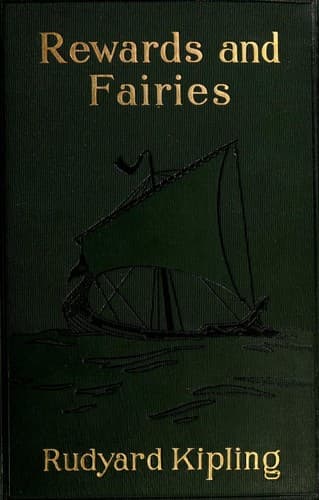
Fairies -- Juvenile fiction; Fantasy literature; Short stories, English; Siblings -- Juvenile fiction
‘“I think Rahere is jealous of you,” said he, smiling, to Nigel of Ely.
He was one bishop; and William of Exeter, the other--Wal-wist the Saxons
called him--laughed long. “Rahere is a priest at heart. Shall I make him
a bishop, De Aquila?” says the King.
‘“There might be worse,” said our Lord of Pevensey. “Rahere would never
do what Anselm has done.”
‘This Anselm, Archbishop of Canterbury, had gone off raging to the Pope
at Rome, because Henry would make bishops without his leave either. I
knew not the rights of it, but De Aquila did, and the King laughed.
‘“Anselm means no harm. He should have been a monk, not a bishop,” said
the King. “I’ll never quarrel with Anselm or his Pope till they quarrel
with my England. If we can keep the King’s peace till my son comes to
rule, no man will lightly quarrel with our England.”
‘“Amen,” said De Aquila. “But the King’s peace ends when the King dies.”
‘That is true. The King’s peace dies with the King. The custom then is
that all laws are outlaw, and men do what they will till the new King is
chosen.
‘“I will amend that,” said the King hotly. “I will have it so that
though King, son, and grandson were all slain in one day, still the
King’s peace should hold over all England! What is a man that his mere
death must upheave a people? We must have the Law.”
‘“Truth,” said William of Exeter; but that he would have said to any
word of the King.
‘The two great barons behind said nothing. This teaching was clean
against their stomachs, for when the King’s peace ends, the great barons
go to war and increase their lands. At that instant we heard Rahere’s
voice returning, in a scurril Saxon rhyme against William of Exeter:
‘“Well wist Wal-wist where lay his fortune
When that he fawned on the King for his crozier,”
and amid our laughter he burst in, with one arm round Hugh, and one
round the old pilgrim of Netherfield.
‘“Here is your knight, Brother,” said he, “and for the better disport of
the company, here is my fool. Hold up, Saxon Samson, the gates of Gaza
are clean carried away!”
‘Hugh broke loose, white and sick, and staggered to my side; the old man
blinked upon the company.
‘We looked at the King, but he smiled.
‘“Rahere promised he would show me some sport after supper to cover his
morning’s offence,” said he to De Aquila. “So this is thy man, Rahere?”
‘“Even so,” said Rahere. “My man he has been, and my protection he
has taken, ever since I found him under the gallows at Stamford Bridge
telling the kites atop of it that he was--Harold of England!”
‘There was a great silence upon these last strange words, and Hugh hid
his face on my shoulder, woman-fashion.
‘“It is most cruel true,” he whispered to me. “The old man proved it
to me at the beat after you left, and again in our hut even now. It is
Harold, my King!”
‘De Aquila crept forward. He walked about the man and swallowed.
‘“Bones of the Saints!” said he, staring.
‘“Many a stray shot goes too well home,” said Rahere.
Public-domain text, read in full here on John Shaqi.
Reviews
Reviews
No reviews yet
Be the first to share your thoughts on this work.
Elsewhere in the archive
Join the Discussion
Join the discussion
Sign in to leave a comment or review.
Sign InorCreate an account