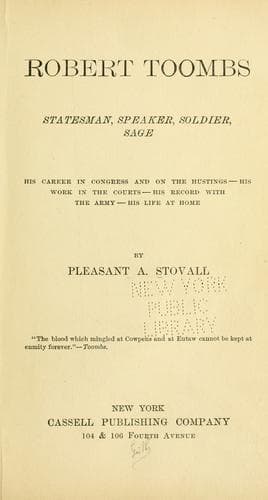
Robert Toombs: Statesman, Speaker, Soldier, SageStovall, Pleasant A.
History
Robert Toombs: Statesman, Speaker, Soldier, Sage
Stovall, Pleasant A.
Toombs, Robert Augustus, 1810-1885
As Senator
Toombs had declared: "The question of slavery moves not the people of
Georgia one-half so much as the fact that you insult their rights as a
community. Abolitionists are right when they say that there are
thousands and tens of thousands of people in Georgia who do not own
slaves. A very large portion of the people of Georgia own none of them.
In the mountains there are but a few of them; but no part of our people
is more loyal to race and country than our bold and hardy mountain
population, and every flash of the electric wire brings me cheering news
from our mountain-tops and our valleys that these sons of Georgia are
excelled by none of their countrymen in loyalty to their rights, the
honor and glory of the commonwealth. They say, and well say, this is our
question: we want no negro equality; no negro citizenship; we want no
mongrel race to degrade our own, and, as one man, they would meet you
upon the border with the sword in one hand and the torch in the other.
They will tell you, 'When we choose to abolish this thing (slavery), it
must be done under our direction, according to our will. Our own, our
native land shall determine this question, and not the Abolitionists of
the North.' That is the spirit of our freemen."
The spirit of the people was plainly manifested by the zeal and ardor of
Thomas R. R. Cobb. He was a young man who went into the secession
movement with lofty enthusiasm. He had all the ardor and religious
fervor of a crusader. He had never held public office, and had taken no
hand in politics until the time came for Georgia to secede. He was the
younger brother of Howell Cobb. He declared that what Mr. Stephens said
was the determining sentiment of the hour, that "Georgia could make
better terms out of the Union than in it." The greater part of the
people was fired with this fervor, which they felt to be patriotic.
Gray-bearded men vied with the hot blood of youth, and a venerable
citizen of Augusta, illuminating his residence from dome to cellar,
blazoned with candles this device upon his gateway--"Georgia, right or
wrong--Georgia!" Never was a movement so general, so spontaneous. Those
who charged the leaders of that day with precipitating their States into
revolution upon a wild dream of power, did not know the spirit and the
temper of the people who composed that movement. Northern men who had
moved South and engaged in business, as a general thing, stood shoulder
to shoulder with their Southern brethren, and went out with the
companies that first responded to the call to war. The South sacrificed
much, in a material point of view, in going into civil conflict. In the
decade between 1850 and 1860, the wealth of the South had increased
three billions of dollars, and Georgia alone had shown a growth measured
by two hundred millions. Her aggregate wealth at the time she passed the
Ordinance of Secession was six hundred and seventy-two millions, double
what it is to-day.
Public-domain text, read in full here on John Shaqi.
Reviews
Reviews
No reviews yet
Be the first to share your thoughts on this work.
Elsewhere in the archive
Join the Discussion
Join the discussion
Sign in to leave a comment or review.
Sign InorCreate an account