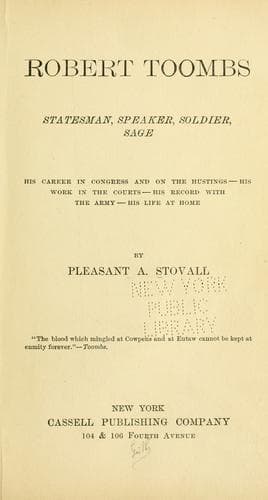
Robert Toombs: Statesman, Speaker, Soldier, SageStovall, Pleasant A.
History
Robert Toombs: Statesman, Speaker, Soldier, Sage
Stovall, Pleasant A.
Toombs, Robert Augustus, 1810-1885
The address to the people of Georgia adopted by this convention, was
written by Mr. Toombs. It recited that "our people are still attached to
the Union from habit, national tradition, and aversion to change." The
address alluded to our "Northern Confederates" and declared that the
issue had been "deliberately forced by the North and deliberately
accepted by the South. We refuse to submit to the verdict of the North,
and in vindication we offer the Constitution of our country. The people
of Georgia have always been willing to stand by this compact; but they
know the value of parchment rights in treacherous hands." The report
charged that the North had outlawed three thousand millions of our
property, put it under a ban, and would subject us, not only to a loss
of our property, but to destruction of our homes and firesides. It
concludes: "To avoid these evils, we withdraw the powers that our
fathers delegated to the government of the United States, and henceforth
seek new safeguards for our liberty, security, and tranquillity."
On the 4th of February, 1861, forty-two delegates met at Montgomery,
Ala. The States of Alabama, Florida, Georgia, Louisiana, Mississippi,
and South Carolina were represented. Howell Cobb of Georgia was chosen
President of the Provisional Congress. Mr. Stephens said it was the most
intellectual body of men he had ever seen. One of the first duties of
this convention was to elect a President and vice president of the new
Confederacy. All eyes were turned to Robert Toombs. It was by common
consent agreed that Georgia, owing to her commanding position, her
prominence in the movement, and her wealth of great men, should furnish
the President. Toombs towered even above the members of that convention.
Bold, imperious, and brainy, he had guided the revolution without haste
or heat, and his conservative course in the Georgia convention had
silenced those critics who had called him "the genius of the
revolution," but denied to him the constructive power to build upon the
ruins he had made. He had, in the choice of delegates to the Provisional
Congress, boldly advocated the election of Mr. Stephens from his own
district, although the latter was a Union man and, at that time, was not
on good terms with Toombs. Toombs declared that Alexander Stephens was a
patriot notwithstanding his views against secession. He had secured the
recommitment of a dangerous resolution upon slavery which, he declared,
would injure the South by the announcement of an ultra policy. He had
written a very conservative letter to Senator Crittenden. He had been a
prominent Secessionist, and had contemplated the movement as unavoidable
when men were talking with bated breath. But in the opening of the
revolution, he had proven a safe counselor. Mr. Toombs was approached,
and announced that he would accept the presidency if it were offered
with unanimity. He was surprised to learn that the delegates from four
States had agreed on Jefferson Davis.
Public-domain text, read in full here on John Shaqi.
Reviews
Reviews
No reviews yet
Be the first to share your thoughts on this work.
Elsewhere in the archive
Join the Discussion
Join the discussion
Sign in to leave a comment or review.
Sign InorCreate an account