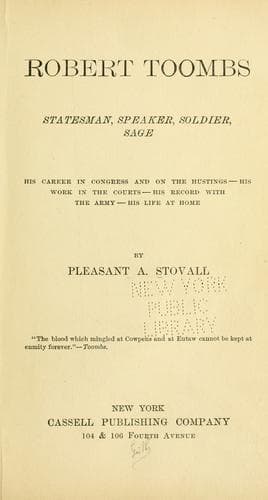
Robert Toombs: Statesman, Speaker, Soldier, SageStovall, Pleasant A.
History
Robert Toombs: Statesman, Speaker, Soldier, Sage
Stovall, Pleasant A.
Toombs, Robert Augustus, 1810-1885
In the perfection of a permanent government and the new-molding of a
Constitution, Mr. Toombs was now diligently engaged. The principal
changes brought about by him may be briefly recalled. It was specified,
in order to cut off lobby agents, that Congress should grant no extra
compensation to any contractor after the service was rendered. This item
originated with Mr. Toombs, who had noted the abuses in the Federal
Government. Congress was authorized to grant to the principal officer of
each of the executive departments a seat upon the floor of either house,
without a vote, but with the privilege of discussing any measure
relating to his department. This was an old idea of Mr. Toombs, and
during his visit abroad, he had attended sessions of the British
Parliament in company with Mr. Buchanan, then Minister to England. He
had been impressed with the value of the presence in Parliament of the
Ministers themselves. During a debate in the United States Senate in
1859, Mr. Toombs had said: "My own opinion is that it would be a great
improvement on our system if the Cabinet officers should be on the floor
of both Houses, and should participate in the debate; I have no doubt
that we should thus get rid of one of the greatest difficulties in our
Constitution."
Mr. Toombs also incorporated into the organic law a prohibition of the
payment of bounties and of the internal improvement system. There was a
tax upon navigation for harbors, buoys, and beacons, but this was
adjusted upon the Toombs principle of taxing the interest for which the
burden was levied. Mr. Toombs was made chairman of the Finance Committee
of the Provisional Congress. This appointment was received with general
satisfaction. His long legislative experience, his genius for finance,
and his executive power, fitted him for this position. To provide ways
and means for the new nation which was, as yet, without resources or a
system of taxation, involved no little difficulty. It was important that
the young Confederacy should exhibit resources sufficient to equip her
armies and maintain herself before she could sue for independence or
foreign recognition. It was for these admitted qualities of Mr. Toombs
for details and management, that President Davis preferred him to take
the position of Secretary of the Treasury. Next to the presidency this
was his real place, but it was suggested that a man like Toombs deserved
the first position in the new Cabinet. A telegram from President Davis,
offering him the portfolio of Secretary of State, reached Mr. Toombs in
Augusta. He at first declined, but being urged by Mr. Stephens, finally
consented to serve. The Cabinet was then made up as follows. Robert
Toombs of Georgia, Secretary of State; C. G. Memminger of South
Carolina, Secretary of the Treasury; L. P. Walker of Alabama, Secretary
of War; J. H. Reagan of Texas, Postmaster-General; J. P. Benjamin of
Louisiana, Attorney-General; S. B. Mallory of Florida, Secretary of the
Navy.
CHAPTER XXI.
Public-domain text, read in full here on John Shaqi.
Reviews
Reviews
No reviews yet
Be the first to share your thoughts on this work.
Elsewhere in the archive
Join the Discussion
Join the discussion
Sign in to leave a comment or review.
Sign InorCreate an account