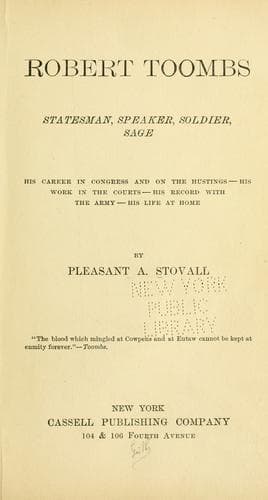
Robert Toombs: Statesman, Speaker, Soldier, SageStovall, Pleasant A.
History
Robert Toombs: Statesman, Speaker, Soldier, Sage
Stovall, Pleasant A.
Toombs, Robert Augustus, 1810-1885
Carlyle declared with dyspeptic acrimony that the Civil War was the
foulest chimney of the century, and should be allowed to burn out.
Secretary Toombs had issued credentials to commissioners to the
unseceded Southern States. On the 17th of April Virginia seceded; on the
28th of May North Carolina went out of the Union; these were followed by
Tennessee and Arkansas. The border States of Kentucky and Missouri did
not formally secede, but indignantly declined to furnish troops in
response to Mr. Lincoln's proclamation. They appointed delegates to a
Peace Congress to meet in Washington.
The tedious routine of the State Department did not suit the restless
spirit of Robert Toombs. He had established relations abroad as
belligerents, and had placed the new government in touch with its
Southern neighbors. His dispatches were remarkable for brevity,
clearness, and boldness; his public papers are models of nervous style,
but he longed for a more active field in the revolution. He chafed under
red-tape and convention. Toombs charged the new administration with too
much caution and timidity. He declared that ninety per cent of war was
business, and that the South must organize victory rather than trust
entirety to fighting. He urged the government to send over cotton to
England and buy arms and ships forthwith. "Joe Brown," he impatiently
declared, "had more guns than the whole Confederacy. No new government,"
said he, "ever started with such unlimited credit." Mr. Toombs believed
that the financial part of the Confederacy was a failure. "We could have
whipped the fight," said he, in his impetuous way, "in the first sixty
days. The contest was haphazard from the first, and nothing but
miraculous valor kept it going." Mr. Toombs said that had he been
President of the Confederacy, he would have mortgaged every pound of
cotton to France and England at a price that would have remunerated the
planters, and in consideration of which he would have secured the aid of
the armies and navies of both countries.
But Robert Toombs concluded that his place was in the field, not in the
Cabinet. Too many prominent men, he explained, were seeking bombproof
positions. He received a commission as brigadier general, and on the
21st of July, 1861, joined Generals Beauregard and Johnston at Manassas.
CHAPTER XXII.
BRIGADIER GENERAL IN ARMY OF NORTHERN VIRGINIA.
Public-domain text, read in full here on John Shaqi.
Reviews
Reviews
No reviews yet
Be the first to share your thoughts on this work.
Elsewhere in the archive
Join the Discussion
Join the discussion
Sign in to leave a comment or review.
Sign InorCreate an account