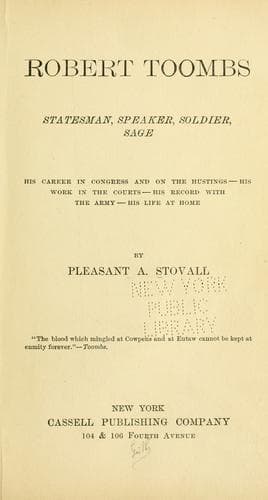
Robert Toombs: Statesman, Speaker, Soldier, SageStovall, Pleasant A.
History
Robert Toombs: Statesman, Speaker, Soldier, Sage
Stovall, Pleasant A.
Toombs, Robert Augustus, 1810-1885
During his travels General Toombs did not wear a disguise of any sort.
Dressed in a checked suit, and riding his gray mare, he was a prominent
object, and to most of the people was well known. One day he wore green
goggles, but soon threw them away in disgust. The nearness of troops
forced General Toombs to abandon his plan of going home for his family
before leaving the country. He dispatched Lieutenant Irvin to Washington
with letters to his wife, telling her that he would not see her again
until he had gone abroad, when he would send for her to join him. He
himself passed through Centreville, twelve miles from his home, and
directed his young guide where to meet him in middle Georgia. This
Lieutenant Irvin found it very hard to do. General Toombs was very
discreet as to whom he took into his confidence. Once or twice he
cautioned his companion against certain parties, to the surprise of the
young man. Toombs, however, read human nature pretty well, and, later,
when the real character of these persons developed, Irvin understood the
counsels of his older friend. So carefully did General Toombs cover his
tracks that Lieutenant Irvin, after his detour to Washington, was a long
time in overtaking him. Traveling straight to Sparta, Lieutenant Irvin
called on Judge Linton Stephens and asked about the general. This shrewd
Georgian came to the door and flatly denied knowing anything about
Toombs.
"He questioned me closely," said Lieutenant Irvin, "and finding that I
was really who I pretended to be, finally agreed to take me to Toombs.
Riding down to Old-Town, in Jefferson County, we failed to find Toombs,
but receiving a clew that he had passed through the David Dickson
plantation in Hancock County, I accosted Mr. Worthen, the manager. 'Has
an old man riding a gray horse passed this way,' Worthen was asked. He
promptly answered, 'No.' Believing that he was deceiving me, I
questioned him more closely."
Worthen tried to persuade the young man to get down and take some plums.
He was evidently anxious to detain him. Finally he eyed the stranger
more closely, and, convinced that he was the companion whom Toombs
expected, he confessed that General Toombs had been at his place and was
then at the home of Major Gonder in Washington County.
Lieutenant Irvin had ridden over two hundred miles in this search and
lost two or three days out of his way. Toombs covered his trail so
carefully that it was difficult even for his friends to find him. Small
wonder that he was not captured by the enemy.
Lieutenant Irvin was not yet "out of the woods." Reaching the home of
Major Gonder late in the evening, he rode up to the front fence, fifty
yards from the dwelling. Mrs. Gonder and her daughter were sitting on
the piazza. Lieutenant Irvin asked the usual question about the old man
and the gray horse. The lady replied that she knew nothing about them.
Lieutenant Irvin said: "But I was directed to this place."
Mrs. Gonder: "I should like to know who sent you."
Public-domain text, read in full here on John Shaqi.
Reviews
Reviews
No reviews yet
Be the first to share your thoughts on this work.
Elsewhere in the archive
Join the Discussion
Join the discussion
Sign in to leave a comment or review.
Sign InorCreate an account