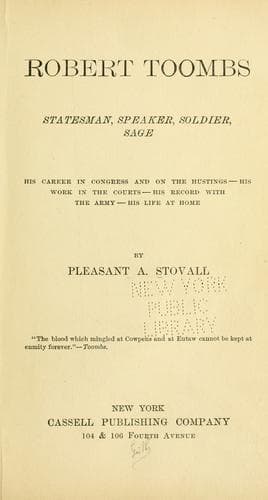
Robert Toombs: Statesman, Speaker, Soldier, SageStovall, Pleasant A.
History
Robert Toombs: Statesman, Speaker, Soldier, Sage
Stovall, Pleasant A.
Toombs, Robert Augustus, 1810-1885
This same negro had been strung up by the thumbs by Sherman's troops a
few months before because he would not tell where his master's mules
were hidden. He piloted General Toombs through the woods to the home of
Colonel David Hughes, a prominent and wealthy farmer of Twiggs County.
Colonel Hughes had been in Toombs' brigade, and the general remained
with him a week.
General Toombs was sitting on the piazza of Colonel Hughes's house one
afternoon when an old soldier asked permission to come in. He still wore
the gray, and was scarred and begrimed. He eyed General Toombs very
closely, and seemed to hang upon his words. He heard him addressed as
Major Martin, and finally, when he arose to leave, wrung the general's
hand.
"Major Martin," he said, brushing the tears from his eyes, "I'm mighty
glad to see you. I wish to God I could do something for you."
At the gate he turned to Colonel Hughes and said: "I know who that is.
It is General Toombs. You can't fool me."
"Why do you think so?" Colonel Hughes asked.
"Oh, I remember Gray Alice jumping the stone walls at Sharpsburg too
well to forget the rider now."
"Colonel," he continued, "this morning a man near here, who is a
Republican and an enemy of General Toombs, thought he recognized him
near your house. He saw him two hundred yards away. I heard him say he
believed it was Toombs and he wished he had his head shot off. I came
here to-night to see for myself. You tell General Toombs that if he says
the word, I will kill that scoundrel as sure as guns."
The veteran was persuaded, however, to keep quiet and do nothing of the
sort.
It was at this time that Lieutenant Irvin found that the ferries of the
Ocmulgee River were guarded from one end to the other. Near this place
Davis had been captured and the Union troops were on a sharp lookout for
Toombs. Convinced that further travel might be hazardous, General Toombs
and his friend rode back to the mountains of North Georgia, and there
remained until the early fall. It was in the month of October that the
fugitives again started on their checkered flight. The May days had
melted into summer, and summer had been succeeded by early autumn. The
crops, planted when he started from home that spring day, were now
ripening in the fields, and Northern statesmen were still declaring that
Toombs was the arch-traitor, and must be apprehended. Davis was in
irons, and Stephens languished in a dungeon at Fortress Monroe.
Passing once more near Sparta, Ga., Toombs met, by appointment, his
friends, Linton Stephens, R. M. Johnson, W. W. Simpson, Jack Lane, Edge
Bird, and other kindred spirits. It was a royal reunion, a sort of
Lucretia Borgia feast for Toombs--"eat and drink to-day, for to-morrow
we may die."
Public-domain text, read in full here on John Shaqi.
Reviews
Reviews
No reviews yet
Be the first to share your thoughts on this work.
Elsewhere in the archive
Join the Discussion
Join the discussion
Sign in to leave a comment or review.
Sign InorCreate an account