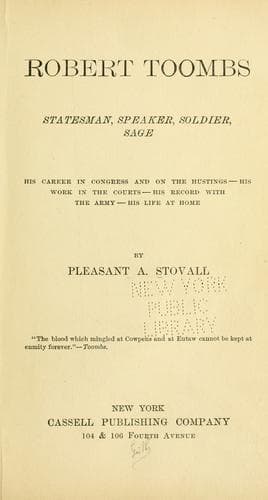
Robert Toombs: Statesman, Speaker, Soldier, SageStovall, Pleasant A.
History
Robert Toombs: Statesman, Speaker, Soldier, Sage
Stovall, Pleasant A.
Toombs, Robert Augustus, 1810-1885
I almost determined to take the steamer Saturday and run
the gauntlet to New York. I would have done so but for my
promise to you. I know everything looks worse and worse on
our side of the ocean, but when will it be any better? Is
this state of things to last forever? To me it is becoming
intolerable.... Kiss the dear little children for me. Bless
their hearts! How I long to see them and take them to my
arms. God bless you! Pray for me that I may be a better man
in the new year than in all the old ones before in my time.
Early in January General Toombs decided to sail for Cuba and thence to
New Orleans. If he found it unsafe to remain in the South he concluded
he could either go back to Cuba or extend his travels into Canada. He
had promised his wife he would remain abroad for the present. But he
writes:
The worst that can happen to me is a prison, and I don't
see much to choose between my present condition and any
decent fort. I feel so anxious about you and the children
that it makes me very wretched.
From Paris, January 16, 1867, he writes:
My preparations are all complete, and I leave to-morrow on
the _New World_ for Havana and New Orleans, _via_
Martinique. I am well; except my throat. I shall have a
long and lonesome voyage, with not much else to cheer me
but that I shall find you and our dear little ones at the
end of my journey. If I am permitted to find you all well,
I shall be compensated for its fatigues and dangers. God
grant that we may all meet once more in this world in
health!
Yours truly and affectionately, as ever,
TOOMBS.
General Toombs returned to America and after a short residence in Canada
went to Washington, where he had a long interview with his old
senatorial colleague, President Andrew Johnson. He went home from
Washington and was never again molested. He made no petition for relief
of political disabilities. He was never restored to citizenship. When
Honorable Samuel J. Randall proposed his General Amnesty Act in 1875,
Mr. Blaine and other Republicans desired to exclude from its provisions
the names of Davis and Toombs. The Democrats would not accept this
amendment, and the bill was never passed. Once, when Senator Oliver P.
Morton asked General Toombs why he did not petition Congress for pardon,
Toombs quietly answered, "Pardon for what? I have not pardoned you all
yet."
CHAPTER XXVI.
COMMENCING LIFE ANEW.
Public-domain text, read in full here on John Shaqi.
Reviews
Reviews
No reviews yet
Be the first to share your thoughts on this work.
Elsewhere in the archive
Join the Discussion
Join the discussion
Sign in to leave a comment or review.
Sign InorCreate an account