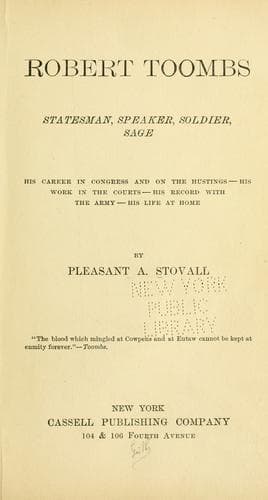
Robert Toombs: Statesman, Speaker, Soldier, SageStovall, Pleasant A.
History
Robert Toombs: Statesman, Speaker, Soldier, Sage
Stovall, Pleasant A.
Toombs, Robert Augustus, 1810-1885
Cut off from all hope of official promotion, scorning to sue for
political pardon, he strove to wield in the courts some of the power he
forfeited in politics. He figured largely in cases of a public nature,
and became an outspoken tribune of the people. He did not hesitate to
face the Supreme Court of Georgia, then made up of Republican judges,
and attack the laws of a Republican legislature. Among the bills passed
at that time to popularize the legislature with the people, was a series
of liberal homestead and exemption laws. They were the relief measures
of 1868. By these schemes, at once rigorous and sweeping, millions of
dollars were lost in Georgia. They were intended to wipe out old debts,
especially contracts made during the war, and Governor Bullock had
appointed a Supreme Court which sustained them. These laws were
abhorrent to Toombs. He thundered against them with all the powers of
his learning and eloquence. When he arose in court, there stood with
him, he believed, not only the cause of his client, but the honor of the
whole State of Georgia. It was much easier to seduce a poverty-stricken
people by offering them measures of relief than to drive them by the
bayonet or to subject them to African domination. In the case of
Hardeman against Downer, in June, 1868, he declared before the Supreme
Court that these homestead laws put a premium on dishonesty and robbed
the poor man of his capital. "But we must consider the intention of the
Act," said the Court. "Was it not the intention of the legislature to
prevent the collection of just such claims as these you now bring?"
"Yes, may it please the Court," said Toombs, shaking his leonine locks,
"there can be no doubt that it was the intention of the legislature to
defraud the creditor; but they have failed to put their intention in a
form that would stand, so it becomes necessary for this Court to add its
own ingenuity to this villainy. It seems that this Court is making laws
rather than decisions."
In one of his dissenting opinions upon these laws, Justice Hiram Warner
declared that he would not allow his name to go down to posterity
steeped in the infamy of such a decision. General Toombs lost his case,
but the decision was subsequently overruled by the Supreme Court of the
United States.
The times were full of evil. The legislature was dominated by
adventurers and ignorant men, and public credit was freely voted away to
new enterprises. The State was undeveloped, and this wholesale system of
public improvement became popular. Unworthy men were scrambling for
public station, and the times were out of tune. In the midst of this
demoralization Toombs was a pillar of fire. He was tireless in his
withering satire, his stinging invective, his uncompromising war upon
the misgovernment of the day.
Public-domain text, read in full here on John Shaqi.
Reviews
Reviews
No reviews yet
Be the first to share your thoughts on this work.
Elsewhere in the archive
Join the Discussion
Join the discussion
Sign in to leave a comment or review.
Sign InorCreate an account