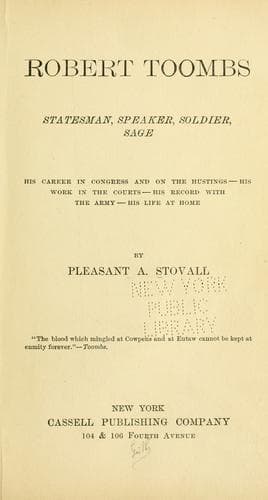
Robert Toombs: Statesman, Speaker, Soldier, SageStovall, Pleasant A.
History
Robert Toombs: Statesman, Speaker, Soldier, Sage
Stovall, Pleasant A.
Toombs, Robert Augustus, 1810-1885
General Toombs kept the issues before the people. He had no patience
with the tentative policy. He forfeited much of his influence at this
time by his indiscriminate abuse of Northern men and Southern opponents,
and his defiance of all the conditions of a restored Union. He could
have served his people best by more conservative conduct, but he had all
the roughness and acerbity of a reformer, dead in earnest. It was owing
to his constant arraignment of illegal acts of the post-bellum regime
that the people finally aroused, in 1870, and regained the State for
white supremacy and Democratic government. He challenged the authors of
the Reconstruction measures to discuss the constitutionality of the
amendments. Charles J. Jenkins had already carried the cause of Georgia
into the courts, and Linton Stephens, before United States Commissioner
Swayze in Macon, had made an exhaustive argument upon the whole subject.
Toombs forced these issues constantly into his cases, and kept public
interest at white heat.
CHAPTER XXVII.
DAYS OF RECONSTRUCTION
In July, 1868, the people of Georgia made the first determined stand
against the Republican party. John B. Gordon was nominated for Governor,
and Seymour and Blair had been named in New York as National Democratic
standard-bearers. A memorable meeting was held in Atlanta. It was the
first real rally of the white people under the new order of things.
Robert Toombs, Howell Cobb, and Benjamin H. Hill addressed the
multitude. There was much enthusiasm, and crowds gathered from every
part of Georgia. This was the great "Bush Arbor meeting" of that year,
and old men and boys speak of it to-day with kindling ardor. "Few
people," said Toombs in that speech, "had escaped the horrors of war,
and fewer still the stern and bitter curse of civil war. The histories
of the greatest peoples of earth have been filled with defeats as well
as victories, suffering as well as happiness, shame and reproach as well
as honor and glory. The struggles of the great and good are the noblest
legacies left by the past to the present generation, trophies worthy to
be laid at the feet of Jehovah himself. Those whose blades glittered in
the foremost ranks of the Northern army on the battlefield, with a yet
higher and nobler purpose denounce the base uses to which the victory
has been applied. The old shibboleths of victory are proclaimed as
living principles. Whatever else may be lost, the principles of Magna
Charta have survived the conflict of arms. The edicts of the enemy
abolish all securities of life, liberty, and property; defeat all the
rightful purposes of government, and renounce all remedies, all laws.["]
Public-domain text, read in full here on John Shaqi.
Reviews
Reviews
No reviews yet
Be the first to share your thoughts on this work.
Elsewhere in the archive
Join the Discussion
Join the discussion
Sign in to leave a comment or review.
Sign InorCreate an account