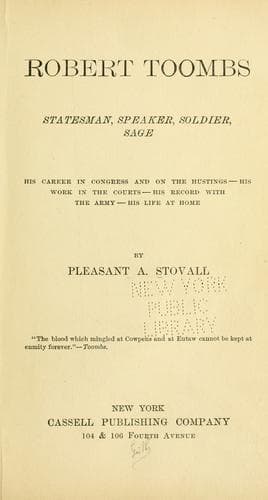
Robert Toombs: Statesman, Speaker, Soldier, SageStovall, Pleasant A.
History
Robert Toombs: Statesman, Speaker, Soldier, Sage
Stovall, Pleasant A.
Toombs, Robert Augustus, 1810-1885
On one occasion in Atlanta, in July, 1872, General Toombs among other
things referred to a lobby at the legislature in connection with a claim
for the Mitchel heirs. Governor Brown had remained quiet during his long
political ostracism, but he turned upon his accuser now with
unlooked-for severity. He answered the charge by declaring that if
Toombs accused him of lobbying this claim, he was an "unscrupulous
liar." The reply did not attract much attention until it became known
that General Toombs had sent a friend to Governor Brown to know if the
latter would accept a challenge. Colonel John C. Nicholls was the
friend, and Governor Brown returned the answer that when he received the
challenge he would let him know. General Toombs did not push the matter
further. The affair took the form of a newspaper controversy, which was
conducted with much acrimony on both sides. Colonel Nicholls stated in
print his belief that Governor Brown would not have accepted a challenge
but would have used it to Toombs' injury before the people. The prospect
of a duel between these two old men created a sensation at the time. It
would have been a shock to the public sense of propriety to have allowed
such a meeting. It would never have been permitted; but Governor Brown
seems to have been determined to put the issue to the touch. He had
prepared his resignation as a deacon of the Baptist Church, and had
placed his house in order. He seemed to realize that this was the
turning-point of his career, and there is no doubt that General Toombs
gave him the opportunity to appear in a better light than he had done
for a long time; this incident was the beginning of his return to
popularity and influence in Georgia. General Toombs was censured for
provoking Governor Brown into the attitude of expecting a challenge and
then declining to send it.
Both General Toombs and Mr. Stephens were believers in the code of
honor. Mr. Stephens once challenged Governor Herschel V. Johnson, and at
another time he called out Hon. Benjamin H. Hill. General Toombs
peremptorily challenged General D. H. Hill after the battle of Malvern
Hill. In 1859, when United States Senator Broderick was killed by Judge
Terry in California, Mr. Toombs delivered a striking eulogy of Broderick
in the United States Senate. He said; "The dead man fell in honorable
contest under a code which he fully recognized. While I lament his sad
fate, I have no censure for him or his adversary. I think that no man
under any circumstances can have a more enviable death than to fall in
vindication of his honor. He has gone beyond censure or praise. He has
passed away from man's judgment to the bar of the Judge of all the
Earth."
CHAPTER XXVIII.
HIS LAST PUBLIC SERVICE.
Public-domain text, read in full here on John Shaqi.
Reviews
Reviews
No reviews yet
Be the first to share your thoughts on this work.
Elsewhere in the archive
Join the Discussion
Join the discussion
Sign in to leave a comment or review.
Sign InorCreate an account