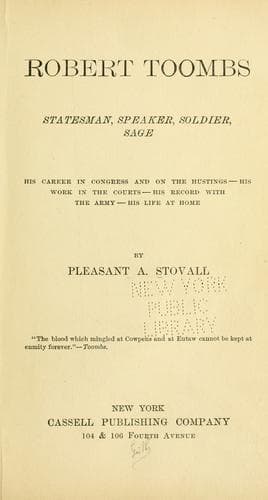
Robert Toombs: Statesman, Speaker, Soldier, SageStovall, Pleasant A.
History
Robert Toombs: Statesman, Speaker, Soldier, Sage
Stovall, Pleasant A.
Toombs, Robert Augustus, 1810-1885
Under these provisions, the Railroad Commission of Georgia was organized
in 1879. This idea, as it finally worked out, was General Toombs'. He
did not favor fixing the rates in the law, but the creation of such a
commission to carry out these provisions. The present law was framed by
Judge William M. Reese, Hon. Samuel Barnett, Ex-Senator H. D. McDaniel,
and Superintendent Foreacre of the Richmond and Danville Railroad. It
has worked well in Georgia. Twice has the legislature attempted to
remodel it, but the people have rallied to its support and have not
permitted it to be amended in so much as a single clause. It has served
as an example for imitation by other States, and was cited as strong
authority in Congress for the creation of the Inter-State Commerce Law.
The railroad men, after fighting it for ten years, have come round to
acknowledge its value. It has stood as a breakwater between the
corporations and the people. It has guaranteed justice to the citizen,
and has worked no injury to the railroads. Under its wise provisions
Georgia has prospered, and leads the Union to-day in railroad building.
And when, during a recent session of the legislature, an attempt was
made to war upon railroad consolidation, the saving, overmastering,
crowning argument of the railroads themselves was that General Toombs
had already secured protection for the people, and that, under his
masterly handiwork, the rights of property and the rights of the people
were safe.
When the convention had concluded its labors, General Toombs went before
the people and threw himself with enthusiasm into the canvass. He took
the stump, and everywhere his voice was heard in favor of the adoption
of the new organic law. Many of the officers whose term had been cut
off, and whose salaries had been reduced, appeared against the
constitution. General Toombs declared that those public men who did not
approve of the lower salaries might "pour them back in the jug." This
homely phrase became a by-word in the canvass. It had its origin in this
way: In the Creek war, in which "Capt. Robert A. Toombs" commanded a
company made up of volunteers from Wilkes, Elbert, and Lincoln counties,
a negro named Kinch went along as whisky sutler. As he served out the
liquor, some of the soldiers complained of the price he asked. His
answer was, "Well, sir, if you don't like it, sir, pour it back in the
jug."
In the State election of December, 1877, the new constitution was
overwhelmingly adopted, and will remain for generations the organic law
of the Empire State of the South.
CHAPTER XXIX.
DOMESTIC LIFE OF TOOMBS.
Public-domain text, read in full here on John Shaqi.
Reviews
Reviews
No reviews yet
Be the first to share your thoughts on this work.
Elsewhere in the archive
Join the Discussion
Join the discussion
Sign in to leave a comment or review.
Sign InorCreate an account