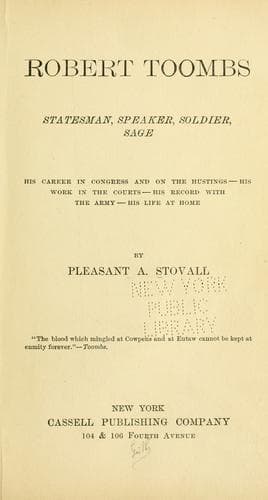
Robert Toombs: Statesman, Speaker, Soldier, SageStovall, Pleasant A.
History
Robert Toombs: Statesman, Speaker, Soldier, Sage
Stovall, Pleasant A.
Toombs, Robert Augustus, 1810-1885
No religious conference could meet in Washington that the Toombs house
was not full of guests. Many Northern people visited the place to hear
the statesman talk. Newspaper correspondents sought him out to listen to
his fine conversation. These people were always sure of the most
courteous treatment, and were prepared for the most candid expression.
General Toombs was not solely a _raconteur_. He did not draw upon his
memory for his wit. The cream of his conversation was his bold and
original comment. His wit flashed all along the line. His speech at
times was droll and full of quaint provincialisms. He treated subjects
spontaneously, in a style all his own. Strangers, who sat near him in a
railroad car, have been enchanted by his sage and spirited conversation,
as his leonine features lighted up, and his irresistible smile and
kindly eye forced good-humor, even where his sentiments might have
challenged dissent. He was the finest talker of his day. A close friend,
who used to visit him frequently at his home, declares that Toombs'
powers did not wait upon the occasion. He did not require an emergency
to bring him out. All his faculties were alert, and in a morning's chat
he would pour out the riches of memory, humor, eloquence, and logic
until the listener would be enthralled by his brilliancy and power. He
delighted to talk with intellectual men and women. He was impatient with
triflers or dolts. He criticised unsparingly, and arraigned men and
measures summarily, but he was a seeker after truth, and even when
severe, was free from malice or envy.
General Toombs was a man of tender sympathies. Distress of his friends
moved him to prompt relief. In 1855 a friend and kinsman, Mr. Pope, died
in Alabama. He had been a railroad contractor and his affairs were much
involved. General Toombs promptly went to his place, bought in his
property for the family, and left the place for the wife and children,
just as it stood. From Mobile he writes a grief-stricken letter to his
wife, December 28, 1855:
Public-domain text, read in full here on John Shaqi.
Reviews
Reviews
No reviews yet
Be the first to share your thoughts on this work.
Elsewhere in the archive
Join the Discussion
Join the discussion
Sign in to leave a comment or review.
Sign InorCreate an account