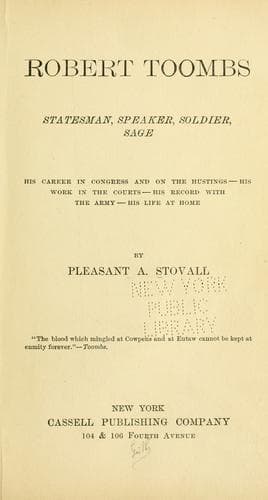
Robert Toombs: Statesman, Speaker, Soldier, SageStovall, Pleasant A.
History
Robert Toombs: Statesman, Speaker, Soldier, Sage
Stovall, Pleasant A.
Toombs, Robert Augustus, 1810-1885
His last public speech was in September, 1884, when the people of
Washington carried him the news of Cleveland's election to the
Presidency. He came to his porch and responded briefly, almost
inaudibly, to the serenade, but he was full of the gratification which
Southern people felt over that event. He declared that he did not know
that there was enough manhood in the country as to break loose from
party ties and elect a President. The fact had revived his hope for the
whole country. He had, before this, taken a gloomy view of the nation.
He had, on one occasion, declared that the injection into the body
politic of three million savages had made good government forever
impossible. He had afterward said that the American Constitution rested
solely upon the good faith of the people, and that would hardly bind
together a great people of diverse interests. "Since 1850," he once
said, "I have never believed this Union to be perpetual. The experience
of the last war will deter any faction from soon making an effort at
secession. Had it not been for this, there would have been a collision
in 1876." But the election of Cleveland he regarded as a national,
rather than a sectional victory--a non-partisan triumph in fact; and it
was at this time, the first occasion since the war, that he expressed
regret that he had not regained his citizenship and gone back into
public life.
But his great power had begun to wane. His tottering gait and hesitating
speech pointed unmistakably to speedy dissolution. The new-born hope for
his country came just as his steps neared "the silent, solemn shore of
that vast ocean he must sail so soon."
In March, 1883, General Toombs was summoned to Atlanta to attend the
funeral of his lifelong friend Mr. Stephens. The latter had been an
invalid for forty years, but was kept in active life by the sheer force
of his indomitable will. Emerging from the war a prisoner, he had
finally secured his release and had been elected United States Senator.
Being prevented from taking his seat, he had returned home and finished
his constitutional review of the "War Between the States." In 1873 he
had been reelected to Congress, where he had remained for ten years,
resigning this position to accept the nomination for Governor of
Georgia, which his party had offered him at a critical moment. It had
been the desire of the "Great Commoner" to "die in harness," and there
is no doubt that his close attention to the arduous duties of Governor
hastened his death. Thousands of Georgians repaired to the State Capitol
to honor his memory, but he who attracted most attention was the gray
and grief-stricken companion who stood by the coffin of the man he had
honored for fifty years. Mr. Stephens, in his diary, recalls the fact
that his first meeting with Mr. Toombs was in court, when the latter
generously offered to lend him money and look after his practice so that
Stephens could take a trip for his health.
Public-domain text, read in full here on John Shaqi.
Reviews
Reviews
No reviews yet
Be the first to share your thoughts on this work.
Elsewhere in the archive
Join the Discussion
Join the discussion
Sign in to leave a comment or review.
Sign InorCreate an account