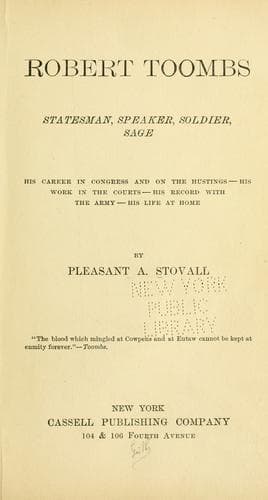
Robert Toombs: Statesman, Speaker, Soldier, SageStovall, Pleasant A.
History
Robert Toombs: Statesman, Speaker, Soldier, Sage
Stovall, Pleasant A.
Toombs, Robert Augustus, 1810-1885
On the 30th of September, 1885, Robert Toombs was confined to his house
by illness. It was a general breaking down of his whole system. It was
evident that he was nearing his end. During his last illness his mind
would wander, and then his faculties would return with singular
clearness. He suffered little pain. As Henry Grady said of him, it
seemed that this kingly power and great vitality, which had subdued
everything else, would finally conquer death. His ruling instinct was
strong in dissolution. He still preserved to the last his faculty of
grasping with ease public situations, and "framing terse epigrams, which
he threw out like proverbs."
During one of his lucid intervals he asked for the news. He was told;
"General, the Georgia Legislature has not yet adjourned."
"Lord, send for Cromwell," he answered, as he turned on his pillow.
Another time he was told that the Prohibitionists were holding an
election in the town. "Prohibitionists," said he, "are men of small
pints."
His mind at this period dwelt mainly on serious thoughts. The Bible was
read to him daily. He was perfectly aware of his condition. He said to
Dr. Steiner: "Looking over my broad field of life, I have not a
resentment. I would not pang a heart."
He talked in his delirium of Mr. Stephens and Dr. Steiner. The latter
recalled him and said: "General, I am here by your side; Mr. Stephens,
you know, has crossed over the river." Coming to himself, he said: "Yes,
I know I am fast passing away. Life's fitful fever will soon be over. I
would not blot out a single act of my life."
Dr. Steiner declared that he never before realized so fully the
appropriateness of Mr. Stephens' tribute to Toombs; "His was the
greatest mind I ever came in contact with. Its operations, even in its
errors, remind me of a mighty waste of waters."
When the time came for Dr. Steiner to return to his home in Augusta,
General Toombs bade him good-by. "I am sorry," said he, "the hour is
come. I hope we shall meet in a better place."
After Thursday, December 10, General Toombs did not regain
consciousness. On Monday, December 15, 1885, at 6 o'clock P. M., he
breathed his last. Just as the darkness of a winter evening stole over
the land the great spirit of the statesman walked into eternal light.
He was buried on Thursday, December 18, at twelve o'clock. The funeral
exercises were held in the little brick Methodist church where his wife
and daughter had worshiped.
The funeral was simple, according to his wishes. A large number of
public men in Georgia attended the services. Dr. Hillyer, a prominent
Baptist divine and classmate of General Toombs, assisted in the
services. Rt. Rev. John W. Beckwith, Episcopal Bishop of Georgia, who
had been his closest religious adviser after the death of the Methodist
Bishop George F. Pierce, delivered a beautiful eulogium.
Public-domain text, read in full here on John Shaqi.
Reviews
Reviews
No reviews yet
Be the first to share your thoughts on this work.
Elsewhere in the archive
Join the Discussion
Join the discussion
Sign in to leave a comment or review.
Sign InorCreate an account