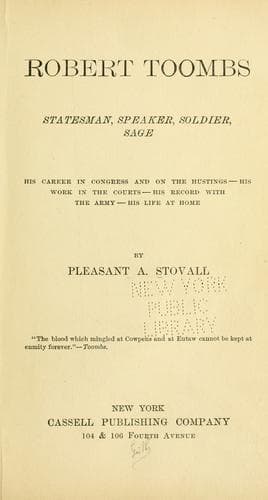
Robert Toombs: Statesman, Speaker, Soldier, SageStovall, Pleasant A.
History
Robert Toombs: Statesman, Speaker, Soldier, Sage
Stovall, Pleasant A.
Toombs, Robert Augustus, 1810-1885
Mr. Toombs repudiated the libel cast by Mr. Sumner upon Northern men who
"dared to exercise the rights of freemen" and differ from the
Abolitionists upon this question. "It appears," said he, "from the
speeches of the senator from Massachusetts, that all such are white
slaves, whose manhood has been debased and enervated by the irresistible
attractions of slave power." He declared that the men who talked about
"solemn compact" in this connection were men whom "no oaths can bind and
no covenants restrain." They called the Missouri Compromise a compact,
yet showed their willingness to violate it.
"In all governments," said Mr. Toombs, "the acquisitions of the state
belong rightfully to the people. Much more strongly does this principle
apply to a purely popular government. Therefore, any exercise of power
to injure or destroy those who have equal rights of enjoyment is
arbitrary, unauthorized by the contract, and despotic."
"You have no power to strike from the meanest Indian trapper, the basest
trader or camp-follower, as the senator from New York styled these
people, their equal privileges, this sovereignty of right, which is the
birthright of every American citizen. This sovereignty may--nay, it
must--remain in abeyance until society becomes sufficiently strong and
stable to be entitled to its full exercise, as sovereignty does not
belong to the general government, and its exercise is a marked
usurpation."
"The power and duty, then, of this government over the inchoate society
of the Territories, is simply to protect this equality of right of
persons and property of all the members of society until the period
shall arrive when this dormant sovereignty shall spring into active
existence and exercise all the powers of a free, sovereign, and
independent State. Then it can mold, according to its own sovereign will
and pleasure, its own institutions, with the single restriction that
they must be republican."
"Justice," said Mr. Toombs, "is the highest expediency, the supremest
wisdom. Applying that test to the principles of this measure, I say that
no fair man in any portion of the country can come to any other
conclusion than that it establishes between the people of this Union,
who are bound together under a common Constitution, a firm, a permanent,
a lasting bond of harmony.
Public-domain text, read in full here on John Shaqi.
Reviews
Reviews
No reviews yet
Be the first to share your thoughts on this work.
Elsewhere in the archive
Join the Discussion
Join the discussion
Sign in to leave a comment or review.
Sign InorCreate an account