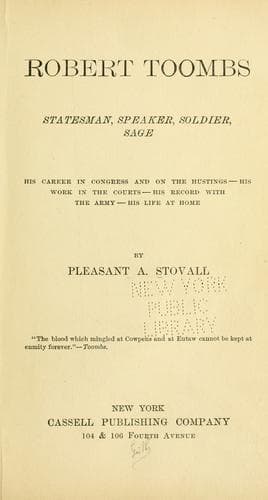
Robert Toombs: Statesman, Speaker, Soldier, SageStovall, Pleasant A.
History
Robert Toombs: Statesman, Speaker, Soldier, Sage
Stovall, Pleasant A.
Toombs, Robert Augustus, 1810-1885
"What is it that we of the South ask? Do we make any unjust or unequal
demands on the North? None. Do we ask what we are not willing on our
side to grant to them? Not at all. We say to them 'Gentlemen, here is
our common territory. Whether it be ceded by old States, whether it be
acquired by the common treasure, or was the fruits of successful war to
which we rallied, and in which we all fought, we ask you to recognize
this great principle of the revolution: let such as desire, go there,
enjoy their property, take with them their flocks and herds, their
men-servants and maid-servants, if they desire to take them there; and
when the appropriate time comes for the exercise of the dormant
sovereignty of the people, let them fix the character of their
institutions for themselves.'"
Senator Toombs ridiculed the idea of the "thunder of popular
indignation." "If even this were true, it should in no wise control the
actions of American senators. But it is not real but melodramatic
thunder--nothing but phosphorus and sheet-iron."
Senator Toombs admitted that the North had the power to reject the
principles of the Kansas-Nebraska bill. They had a majority in the House
and Senate. Aristides had said, "True, you can do it; you have got the
power; but, Athenians, it is unjust."
[Illustration: ROBERT TOOMBS, UNITED STATES SENATOR FROM GEORGIA, 1855.]
Senator Toombs was a bold man. When he adopted a line of argument, he
was willing to follow wherever its conclusions led. He did not
hesitate, in this speech, to admit that "if you yield to the people the
right to mold their institutions, the establishment of polygamy may
result legitimately therefrom." This point had been made in debate to
fight the principle of the Kansas-Nebraska bill. Said Senator Toombs:
"It is just what they have a right to do. When the people of Utah make
their organic law for admission to the Union, they have a right to
approximate, as nearly as they please, the domestic manners of the
Patriarchs. Connecticut may establish polygamy to-morrow. The people of
Massachusetts may do the same. How did they become possessed of greater
rights, in this or any other respect, than the people of Utah? The right
in both cases has the same foundation--the sovereignty of the people."
Public-domain text, read in full here on John Shaqi.
Reviews
Reviews
No reviews yet
Be the first to share your thoughts on this work.
Elsewhere in the archive
Join the Discussion
Join the discussion
Sign in to leave a comment or review.
Sign InorCreate an account