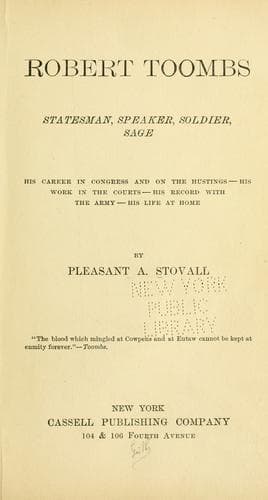
Robert Toombs: Statesman, Speaker, Soldier, SageStovall, Pleasant A.
History
Robert Toombs: Statesman, Speaker, Soldier, Sage
Stovall, Pleasant A.
Toombs, Robert Augustus, 1810-1885
Senator Toombs adverted to the fact that Henry Clay had denied that he
framed the Missouri Compromise; that it did not originate in the House,
of which he was a member; that he did not even know if he voted for it.
Senator Toombs held the Act of 1820 to be no compact--binding upon no
man of honor; but, on the contrary, a plain and palpable violation of
the Constitution and the common rights of the citizens, and ought to be
immediately abrogated and repealed. He declared that it had been
rejected by the North when passed, and rejected when Arkansas was
admitted, when Oregon was formed, when California was received as a
State. If the Kansas bill was settled upon sound and honest principles,
he maintained that it should be applied to territory ceded from France
just as elsewhere. He contended that the Missouri Compromise of 1820 was
not a compromise in any sense of the term, but an unconstitutional
usurpation of power. "When we look into the Constitution, we find no
antislavery power planted in that instrument. On the contrary, we find
that it amply provides for the perpetuity and not for the extinction of
slavery."
Senator Toombs closed his first speech in the Senate with these words:
"The senator from New York asks where and when the application of these
principles will stop. He wishes not to be deceived in the future, and
asks us whether, when we bring the Chinese and other distant nations
under our flag, we are to apply these principles to them? For one, I
answer yes; that wherever the flag of the Union shall float, this
republican principle will follow it, even if it should gather under its
ample folds the freemen of every portion of the universe."
The Kansas-Nebraska bill reopened the whole question of slavery. In the
North, it was a firebrand. Mr. Buchanan, in his book, written after his
retirement from the presidency, said that the South was for the first
time the aggressor in this legislation. Mr. Fillmore declared that the
repeal of the Missouri Compromise was "the Pandora Box of Evil." Mr.
Douglas was reviled by his opponents and burned in effigy at the North.
His leadership in this fight was ascribed to his overweening ambition to
reach the presidency. The clergymen of New England and of Chicago
flooded the Senate with petitions crying against this "intrigue." On May
26, 1854, at one o'clock in the morning, the bill passed the Senate by a
vote of 31 to 13. The "nays" were Messrs. Allen, Bell, Chase, Clayton,
Fish, Foote, Gillet, Hamlin, James, Seward, Sumner, Wade, and Walker.
Public-domain text, read in full here on John Shaqi.
Reviews
Reviews
No reviews yet
Be the first to share your thoughts on this work.
Elsewhere in the archive
Join the Discussion
Join the discussion
Sign in to leave a comment or review.
Sign InorCreate an account