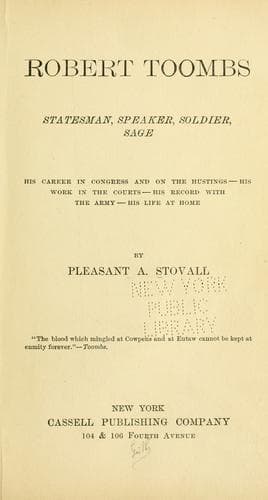
Robert Toombs: Statesman, Speaker, Soldier, SageStovall, Pleasant A.
History
Robert Toombs: Statesman, Speaker, Soldier, Sage
Stovall, Pleasant A.
Toombs, Robert Augustus, 1810-1885
Mr. Hill declared that the Kansas-Nebraska bill embodied the principles
of "squatter sovereignty" and alien suffrage. The bill was not identical
with the Utah and New Mexico bill, as Toombs and Stephens had alleged.
The restrictive provisions of the Utah bill would prohibit this
Territorial Legislature from excluding slavery. It could not do that
until it became a State, while the Kansas bill allowed a majority of the
actual residents to determine whether slavery should or should not
exist, even prior to its admission as a State. He denounced the Kansas
bill as a cheat, a swindle, and a surrender of our dearest rights. As to
the National Convention, Mr. Hill declared that the South may have
framed the platform, but the North secured the candidate. Mr. Hill,
relative to territorial questions, recognized the right of native born
and naturalized citizens of the United States, permanently residing in
any Territory, to frame a constitution and laws and to regulate their
social and domestic affairs in their own way. The American party
proposed to extend the term required for naturalization and to bar the
foreigners from holding office. Mr. Hill had strong sympathizers in the
extreme Southern Rights' men, who were on hand in abundance.
Mr. Toombs replied with great dignity and warmth. He said that the
Nebraska bill was a reiteration of the true intent of the compromise
measures of 1850; that whoever opposed the Kansas bill was opposed to
the South. It was a touchstone for fixing party affiliations. It only
carried out the Georgia platform protesting against Congressional
prohibition of slavery in the Territories. He paid high tribute to
Douglas as a patriot and friend to the South. "Whoever condemned
Douglas needed watching himself." Mr. Toombs charged that the
representatives of the Know-nothing party had voted for the
Kansas-Nebraska bill, and now claimed ignorance of its provisions. He
denied that either he or Mr. Stephens had declared that the Kansas bill
was identical with the Utah bill. Mr. Hill insisted that they had said
so. Affirmance and denial became heated, and talk of holding each other
"personally responsible" was indulged in, but pretty soon the debate
went back into the political grooves. Mr. Toombs denied that the bill
was a "Pandora's box of evil," or that its passage was violative of the
good faith of the South. This part of his argument, of course, was
directed to meet Northern criticism. "The North," Mr. Toombs said, "had
tried, by the Wilmot Proviso, to legislate the South out of the right of
equal enjoyment of the Territories. The South had endeavored to take the
question of these rights out of Congress, to establish the doctrine of
non-intervention." This doctrine triumphed in 1850 and, despite the
assertion of his opponent, was reaffirmed in the Kansas-Nebraska Act.
This Act of 1854 was the great measure of justice and equality to the
South.
Public-domain text, read in full here on John Shaqi.
Reviews
Reviews
No reviews yet
Be the first to share your thoughts on this work.
Elsewhere in the archive
Join the Discussion
Join the discussion
Sign in to leave a comment or review.
Sign InorCreate an account