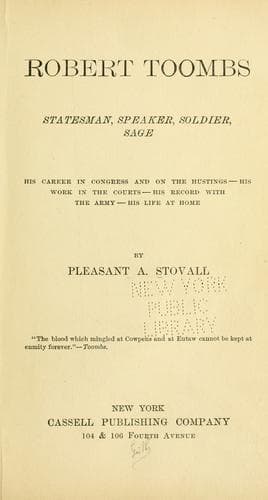
Robert Toombs: Statesman, Speaker, Soldier, SageStovall, Pleasant A.
History
Robert Toombs: Statesman, Speaker, Soldier, Sage
Stovall, Pleasant A.
Toombs, Robert Augustus, 1810-1885
"Sir, I have but little more to add--nothing for myself. I feel that I
have no need to pledge my poor services to this great cause, to my
country. My State has spoken for herself. Nine years ago a convention of
her people met and declared that her connection with this government
depended upon the faithful execution of the Fugitive-slave law. I was a
member of that convention, and I stood then and stand now pledged to its
action. I have faithfully labored to arrest these calamities; I will yet
labor until this last contingency happens, faithfully, honestly, and to
the best of my ability. When that time comes, freemen of Georgia, redeem
your pledges! I am ready to redeem mine. Your honor is involved, your
faith is plighted. I know you feel a stain as a wound. Your peace, your
social system, your friends are involved. Never permit this Federal
Government to pass into the traitors' hands of the black Republican
party. It has already declared war against you and your institutions. It
every day commits acts of war against you; it has already compelled you
to arm for your defense. Listen to no vain babbling; to no treacherous
jargon about 'overt acts'; they have already been committed. Defend
yourselves! The enemy is at your door; wait not to meet him at your
hearthstone; meet him at the door-sill, and drive him from the Temple of
Liberty, or pull down its pillars and involve him in a common ruin."
CHAPTER XVI.
THE CHARLESTON CONVENTION.
It was an unfortunate time for the meeting of the Democratic National
Convention. The hope that the party which had so often brought harmony
from discord could unite upon the soil of an extreme Southern State was
destined to be broken. The body met in Charleston on April 23, 1860. The
place was worthy of the assemblage. For the first time in the party
history, its convention had met south of Cincinnati or Baltimore.
Redolent with the beauties of spring and the tint of historic interest,
Charleston, with its memories of Moultrie, inspired feelings of
patriotic pride. If it suggested the obstruction of Calhoun, it recalled
the Revolutionary glory of Marion and Rutledge, and the bold challenge
of Hayne to Webster, that if there be one State in the Union which could
challenge comparison with any other for a uniform, ardent, and zealous
devotion to the Union, that State was South Carolina.
Public-domain text, read in full here on John Shaqi.
Reviews
Reviews
No reviews yet
Be the first to share your thoughts on this work.
Elsewhere in the archive
Join the Discussion
Join the discussion
Sign in to leave a comment or review.
Sign InorCreate an account