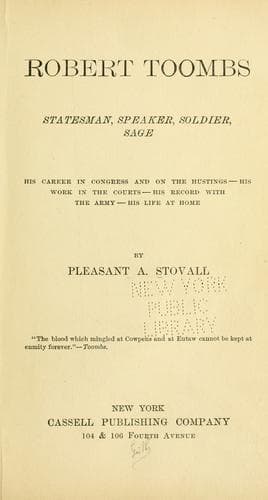
Robert Toombs: Statesman, Speaker, Soldier, SageStovall, Pleasant A.
History
Robert Toombs: Statesman, Speaker, Soldier, Sage
Stovall, Pleasant A.
Toombs, Robert Augustus, 1810-1885
In the United States Senate, on July 31, 1854, Mr. Toombs gave an
elaborate exposition of his views upon the policy of internal
improvements. He said he had maintained opposition to this system as a
fundamental principle. Since he entered public life, he had sustained
President Polk's veto of the River and Harbor bill in 1847. He believed
that Congress had no constitutional power to begin or carry on a general
system of internal improvements. He wanted to know where this power of
the Constitution could be found. Madison and Jefferson had opposed this
system. Monroe, Jackson, and Clay had yielded to the popular pressure
and sanctioned it. "Instead of leaving the taxes or the money in the
pockets of the people," he said, "you have spent nine months in
endeavoring to squander and arranging to have more to squander in the
next Congress. I should like to use a polite term," said he, "for I am a
good-natured man, but I think it is corruption.
"In this bill you offer me seventy thousand dollars for the Savannah
river. Ships were sunk in that river for the common defense of the
country during the Revolutionary War. You are bound to abate your
nuisance at common law. You might offer me this Capitol full of gold,
and I would scorn the gift just less than the giver. You ought to have
removed these obstructions long ago. When we come and ask of you this
act of justice, you tell me to go with you into your internal
improvement bill and take pot-luck with you."
Mr. Toombs claimed that the power given to Congress to regulate
commerce, simply meant to prescribe the rules by which commerce could be
carried on, and nothing else. "The people of Maryland," he said, "had
never asked that the harbor of Baltimore should be cleaned at the
expense of the people of Georgia. They did not ask that other people
should pay their burdens. They came here and asked the privilege of
taxing their own commerce for their own benefit, and we granted it. I
hold it to be a fundamental principle in all governments, and especially
in all free governments, that you should not put burdens on the people
whenever you can discriminate and put them on those who enjoy the
benefits. You started with that principle with your post-office
establishments.
"Senators, is it just? I tell you, as God lives, it is not just, and you
ought not to do it. There is manhood in the people of the Mississippi
Valley. Let them levy tonnage duties for their own rivers and ports and
put up their own lighthouses, and charge the people who use them for the
benefits conferred. Let the honest farmer who makes his hay, who gathers
his cheese, who raises his meal in Vermont, be not taxed to increase
your magnificent improvements of nature and your already gigantic
wealth. Senators, it is unjust."
Public-domain text, read in full here on John Shaqi.
Reviews
Reviews
No reviews yet
Be the first to share your thoughts on this work.
Elsewhere in the archive
Join the Discussion
Join the discussion
Sign in to leave a comment or review.
Sign InorCreate an account