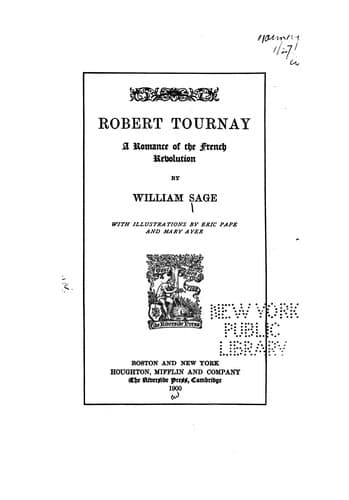
Robert Tournay: A Romance of the French RevolutionSage, William
History
Robert Tournay: A Romance of the French Revolution
Sage, William
France -- History -- Revolution, 1789-1799 -- Fiction
Before replying, the count looked attentively at the group before him:
at the philosopher's impenetrable countenance; at the chevalier's
quizzical and wrinkled brown physiognomy; then at Madame de Rémur's
handsome face, and lastly and most tenderly at the drooping eyelids of
the delicate Mademoiselle de Belloeil.
"She would be twice revered," replied de Blois.
Mademoiselle de Belloeil's needle stopped in its click-click.
"Why so, monsieur le comte?" inquired the philosopher. "If she has a
double motive for the sacrifice, should not the honor of it be only half
as great?"
"She should receive credit for her loyalty to the husband whom she had
sworn to obey, and homage for her devotion to the lover on whom by
nature she has placed her affections," replied the count, bowing to
Madame de Rémur, while he noted with a certain satisfaction the smile of
approval on the lips of Mademoiselle de Belloeil.
"And no one has said that she has a lover," declared Madame de Rémur
warmly.
"Did you not imply as much, dear madame?" asked the old chevalier slyly.
"I intimated that she might have had one--if--let us change the subject.
I move that the poet read us his latest verses. I am dying for some
amusement."
"Ladies and gentlemen," cried the old chevalier, clapping his hands
together to attract the attention of all those in the room, "this
brilliant young author and poet, who needs no introduction to you, has
consented to read his latest production. Will you kindly take places?"
There was some polite applause. "The poem! let us hear the poem," buzzed
upon all sides, and the throng began to settle down around the poet, the
ladies occupying the chairs, and the gentlemen either leaning against
the walls or seated upon stools by the side of those ladies in whose
eyes they found particular favor.
In a few moments a hush of expectancy fell upon an audience delighted at
the prospect of being entertained.
"This is a play in verse," began the poet, taking a roll of manuscript
from his pocket.
"A play! how charming," said Mademoiselle de Belloeil.
"It is in three acts," continued the author. "Act first, in the prison
of the Luxembourg, where the young people first meet and fall deeply in
love."
A rustle of approval ran through his audience.
"Act second is in the prison yard where they are separated, she being
set at liberty and he conducted to the guillotine."
"Oh, how terrible!" murmured the young damsel.
"One moment, monsieur le poëte," said Madame de Rémur. "How does it end?
I warn you that I shall not like your play if it ends unhappily."
"You shall judge of that in a moment, madame," replied the poet, bowing
to her graciously.
"In the third act," he continued, "the lovers are brought together under
the shadow of the guillotine, whither she has followed him. The knife
falls upon both of them in quick succession, and their souls are united
in the next world, never to be separated more."
Public-domain text, read in full here on John Shaqi.
Reviews
Reviews
No reviews yet
Be the first to share your thoughts on this work.
Elsewhere in the archive
Join the Discussion
Join the discussion
Sign in to leave a comment or review.
Sign InorCreate an account