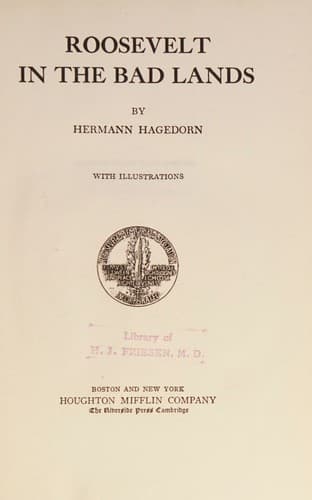
Biography; Frontier and pioneer life -- Dakota Territory; Roosevelt, Theodore, 1858-1919
Early on the morning of the 18th, Roosevelt set his caravan in motion
for the long journey. For a hunting companion he had Merrifield and
for teamster and cook he had a French Canadian named Norman Lebo, who,
as Roosevelt subsequently remarked, to Lebo's indignation (for he
prided himself on his scholarship), "possessed a most extraordinary
stock of miscellaneous mis-information upon every conceivable
subject." He was a short, stocky, bearded man, a born wanderer, who
had left his family once for a week's hunting trip and remained away
three years, returning at last only to depart again, after a week, for
further Odyssean wanderings. "If I had the money," he had a way of
saying, "no two nights would ever see me in the same bed." It was
rumored that before Mrs. Lebo had permitted her errant spouse to go
out of her sight, she had secured pledges from Roosevelt guaranteeing
her three years' subsistence, in case the _wanderlust_ should once
more seize upon her protector and provider.
Roosevelt rode ahead of the caravan, spending the first night with the
Langs, who were always friendly and hospitable and full of good talk,
and rejoining Merrifield and "the outfit" on the Keogh trail a few
miles westward next morning. Slowly and laboriously the "prairie
schooner" lumbered along the uneven route. The weather was sultry, and
as they crossed the high divide which separated the Little Missouri
basin from the valley of the Little Beaver they saw ahead of them the
towering portents of storm. The northwest was already black, and in a
space of time that seemed incredibly brief the masses of cloud boiled
up and over the sky. The storm rolled toward them at furious speed,
extending its wings, as it came, as though to gather in its victims.
[Illustration: Group of Bad Lands citizens. "Old man" Lebo is the
second from the left, seated; to right of him is A. C. Huidekoper,
whose H. T. horse-ranch was famous; beside him is Hell-Roaring Bill
Jones; James Harmon is behind Huidekoper; at the right of the group
(standing) is Schuyler Lebo; at the left, standing beside the Indian
is Charles Mason, famous, above all, for his nickname which (with no
irreverent intent) was "Whistling Jesus."]
Against the dark background of the mass [Roosevelt wrote,
describing it later] could be seen pillars and clouds of
gray mist, whirled hither and thither by the wind, and
sheets of level rain driven before it. The edges of the
wings tossed to and fro, and the wind shrieked and moaned as
it swept over the prairie. It was a storm of unusual
intensity; the prairie fowl rose in flocks from before it,
scudding with spread wings toward the thickest cover, and
the herds of antelope ran across the plain like race-horses
to gather in the hollows and behind the low ridges.
Public-domain text, read in full here on John Shaqi.
Reviews
Reviews
No reviews yet
Be the first to share your thoughts on this work.
Elsewhere in the archive
Join the Discussion
Join the discussion
Sign in to leave a comment or review.
Sign InorCreate an account