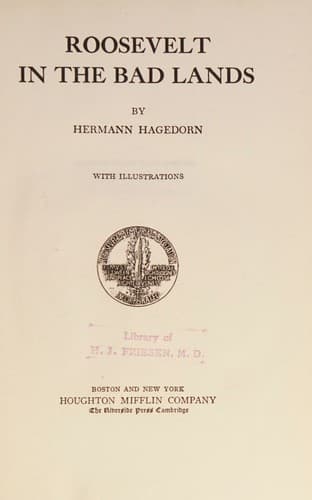
Biography; Frontier and pioneer life -- Dakota Territory; Roosevelt, Theodore, 1858-1919
Lang's love of an argument, which to unfriendly ears might have
sounded like contentiousness, did not serve to make the excellent
Scotchman popular with his neighbors. He had a habit, moreover, of
saying exactly what he thought, regardless of whom he might hit. He
was not politic at all. He had, in fact, come to America and to Dakota
too late in life altogether to adapt a mind, steeped in the manners
and customs of the Old World, to the new conditions of a country in
almost every way alien to his own. He was dogmatic in his theories of
popular government and a little stubborn in his conviction that there
was nothing which the uneducated range-rider of the Bad Lands could
teach a thinking man like him. But his courage was fine. Against the
protests of his Southern neighbors, he insisted on treating a negro
cowboy in his outfit as on complete equality with his white employees;
and bore the storm of criticism with equanimity. Such a spirit was
bound to appeal to Roosevelt.
At the Maltese Cross there was a steady stream of callers. One of
them, a hawk-eyed, hawk-nosed cowpuncher named "Nitch" Kendley, who
was one of the first settlers in the region, arrived one day when
Roosevelt was alone.
"Come on in," said Roosevelt, "and we'll have some dinner. I can't
bake biscuits, but I can cook meat. If you can make the biscuits, go
ahead, and I will see what I can do for the rest of the dinner."
So "Nitch" made the biscuits and put them in the oven, and Roosevelt
cut what was left of a saddle of venison and put it in a pan to fry.
Then the two cooks went outdoors, for the cabin was small, and the
weather was hot.
Roosevelt began to talk, whereupon "Nitch," who had ideas of his own,
began to talk also with a fluency which was not customary, for he was
naturally a taciturn man. They both forgot the dinner. "Nitch" never
knew how long they talked.
They were brought back to the world of facts by a smell of burning.
The cabin was filled with smoke, and "you could not," as "Nitch"
subsequently remarked, "have told your wife from your mother-in-law
three feet away." On investigation it proved that "Nitch's" biscuits
and Roosevelt's meat were burnt to cinders.
Merrifield and Sylvane were out after deer, and Roosevelt and his
companion waited all afternoon in vain for the two men to return. At
last, toward evening, Roosevelt made some coffee, which, as "Nitch"
remarked, "took the rough spots off the biscuits."
"If we'd talked less," reflected "Nitch," "we'd have had more dinner."
Roosevelt laughed. He did not seem to mind the loss of a meal. "Nitch"
was quite positive that he was well repaid. They went on talking as
before.
XVI
He went so high above the earth,
Lights from Jerusalem shone.
Right thar we parted company,
And he came down alone.
I hit terra firma,
The buckskin's heels struck free,
And brought a bunch of stars along
To dance in front of me.
_Cowboy song_
Public-domain text, read in full here on John Shaqi.
Reviews
Reviews
No reviews yet
Be the first to share your thoughts on this work.
Elsewhere in the archive
Join the Discussion
Join the discussion
Sign in to leave a comment or review.
Sign InorCreate an account