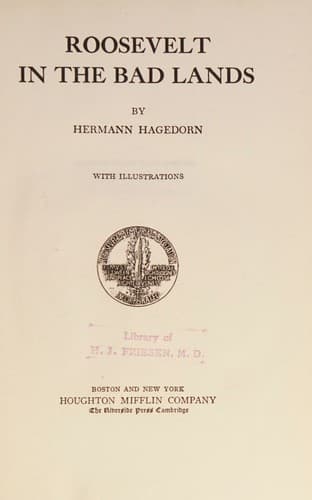
Biography; Frontier and pioneer life -- Dakota Territory; Roosevelt, Theodore, 1858-1919
Then one caper of repulsion
Broke that hawse's back in two.
Cinches snapped in the convulsion;
Skyward man and saddle flew.
Up he mounted, never laggin',
While we watched him through our tears,
And his last thin bit of braggin'
Came a-droppin' to our ears--
"_If you'd ever watched my habits very close,
You would know I've broke such rabbits by the gross.
I have kep' my talent hidin';
I'm too good for earthly ridin',
And I'm off to bust the lightnin'--Adios!_"
Badger CLARK
If Roosevelt anticipated that he would have trouble with his untamed
broncos, he was not disappointed. "The effort," as he subsequently
remarked, "both to ride them, and to look as if I enjoyed doing so, on
some cool morning when my grinning cowboy friends had gathered round
'to see whether the high-headed bay could buck the boss off,'
doubtless was of benefit to me, but lacked much of being enjoyable."
One morning, when the round-up "outfits" were camped on the Logging
Camp Range, south of the Big Ox Bow, Roosevelt had a memorable
struggle with one of his four broncos. The camp was directly behind
the ranch-house (which the Eaton brothers owned), and close by was a
chasm some sixty feet deep, a great gash in the valley which the
torrents of successive springs had through the centuries cut there.
The horse had to be blindfolded before he would allow a saddle to be
put on him.
Lincoln Lang was among the cowboys who stood in an admiring circle,
hoping for the worst.
"Mr. Roosevelt mounted, with the blind still on the horse," Lang said,
telling the story afterward, "so that the horse stood still, although
with a well-defined hump on his back, which, as we all knew very well,
meant trouble to come. As soon as Mr. Roosevelt got himself fixed in
the saddle, the men who were holding the horse pulled off the blind
and turned him loose."
Here Bill Dantz, who was also in the "gallery," takes up the story:
"The horse did not buck. He started off quietly, in fact, until he was
within a few feet of the chasm. Then he leapt in the air like a shot
deer, and came down with all four feet buckled under him, jumped
sideways and went in the air a second time, twisting ends."
Here Lang resumes the narrative:
"Almost any kind of a bucking horse is hard to ride, but the worst of
all are the 'sunfishers' who change end for end with each jump,
maintaining the turning movement in one direction so that the effect
is to get the rider dizzy. This particular horse was of that type, and
almost simultaneous with the removal of the blind he was in gyroscopic
action.
Public-domain text, read in full here on John Shaqi.
Reviews
Reviews
No reviews yet
Be the first to share your thoughts on this work.
Elsewhere in the archive
Join the Discussion
Join the discussion
Sign in to leave a comment or review.
Sign InorCreate an account