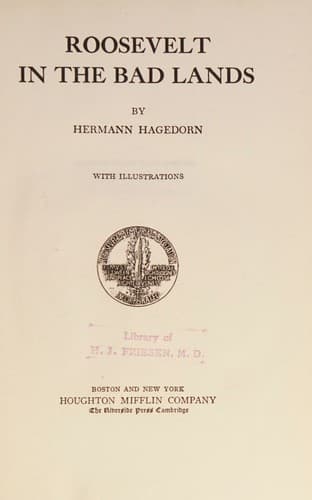
Biography; Frontier and pioneer life -- Dakota Territory; Roosevelt, Theodore, 1858-1919
Here there were feasts of song and story
And words of love and dreams of glory!
Here there were friends! Ah, night will fall
And clouds or the stars will cover all,
But I, when I go as a ghost again
To the gaunt, grim buttes, to the friendly plain
I know that for all that time can do
To scatter the faithful, estrange the true--
Quietly, in the lavender sage,
Will be waiting the friends of my golden age.
From _Medora Nights_
The wild riding, the mishaps, the feverish activity, the smell of the
cattle, the dust, the tumult, the physical weariness, the comradeship,
the closeness to life and death--to Roosevelt it was all magical and
enticing. He loved the crisp morning air, the fantastic landscape, the
limitless spaces, half blue and half gold. His spirit was sensitive to
beauty, especially the beauty that lay open for all in the warm light
of dawn and dusk under the wide vault of heaven; and the experiences
that were merely the day's work to his companions to him were edged
with the shimmer of spiritual adventure.
"We knew toil and hardship and hunger and thirst," Roosevelt wrote
thirty years later, "and we saw men die violent deaths as they worked
among the horses and cattle, or fought in evil feuds with one another;
but we felt the beat of hardy life in our veins, and ours was the
glory of work and the joy of living."
"It was a wonderful thing for Roosevelt," said Dr. Stickney. "He
himself realized what a splendid thing it was for him to have been
here at that time and to have had sufficient strength in his character
to absorb it. He started out to get the fundamental truths as they
were in this country and he never lost sight of that purpose all the
time he was here."
To the joy of strenuous living was added, for Roosevelt, the
satisfaction of knowing that the speculation in which he had risked so
large a part of his fortune was apparently prospering. The cattle were
looking well. Even pessimistic Bill Sewall admitted that, though he
would not admit that he had changed his opinion of the region as a
place for raising cattle.
I don't think we shall lose many of our cattle this winter
[he wrote his brother]. I think they have got past the worst
now. Next year is the one that will try them. It is the cows
that perish mostly and we had but few that had calves last
spring, but this spring thare will be quite a lot of them.
The calves suck them down and they don't get any chance to
gain up before they have another calf and then if the
weather is very cold they are pretty sure to die. It is too
cold here to raise cattle that way. Don't believe there is
any money in she cattle here and am afraid thare is not much
in any, unless it is the largest heards, and they are
crowding in cattle all the time and I think they will eat us
out in a few years.
Public-domain text, read in full here on John Shaqi.
Reviews
Reviews
No reviews yet
Be the first to share your thoughts on this work.
Elsewhere in the archive
Join the Discussion
Join the discussion
Sign in to leave a comment or review.
Sign InorCreate an account