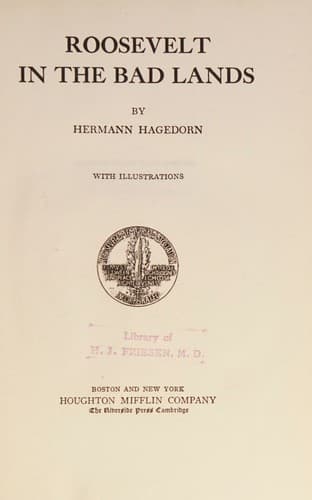
Biography; Frontier and pioneer life -- Dakota Territory; Roosevelt, Theodore, 1858-1919
"What I can't make out," said the ranchman from the Killdeers, with a
puzzled expression on his deeply wrinkled, tough old face, which
Sewall said "looked like the instep of an old boot that had lain out
in the weather for years,"--"what I can't make out is why you make all
this fuss instead of hanging 'em offhand."
Roosevelt grinned, and the following evening, after a
three-hundred-mile journey, deposited three men who had defied the
laws of Dakota in the jail at Dickinson.
He was not a vision of beauty as he emerged from the jail to find a
place to scrape off two weeks' accumulation of Dakota mud. His feet
were in bad shape from the long march through the gumbo, and he asked
the first man he met where he could find a physician. By a curious
coincidence the man he addressed happened to be the only physician
within a hundred and fifty miles in any direction. It was Dr.
Stickney.
They had heard of each other, and Roosevelt was glad, for more reasons
than one, to follow him to his office. For the quiet man with the
twinkling eyes, who combined the courage and the humanness of a
cowpuncher with the unselfish devotion of a saint, was a great figure
in the Bad Lands. Like Roosevelt he was under thirty.
The doctor, in after years, told of that morning's visit. "He did not
seem worn out or unduly tired," he said. "He had just come from the
jail, having deposited his prisoners at last, and had had no sleep for
forty-eight hours, and he was all teeth and eyes; but even so he
seemed a man unusually wide awake. You could see he was thrilled by
the adventures he had been through. He did not seem to think he had
done anything particularly commendable, but he was, in his own phrase,
'pleased as Punch' at the idea of having participated in a real
adventure. He was just like a boy.
"We talked of many things that day while I was repairing his blistered
feet. He impressed me and he puzzled me, and when I went home to
lunch, an hour later, I told my wife that I had met the most peculiar,
and at the same time the most wonderful, man I had ever come to know.
I could see that he was a man of brilliant ability and I could not
understand why he was out there on the frontier. I had heard his name
and I had read something of his work in the New York Legislature and
in the Republican Convention, two years previous, and it seemed to me
that he belonged, not here on the frontier, but in the East, in the
turmoil of large affairs."
Public-domain text, read in full here on John Shaqi.
Reviews
Reviews
No reviews yet
Be the first to share your thoughts on this work.
Elsewhere in the archive
Join the Discussion
Join the discussion
Sign in to leave a comment or review.
Sign InorCreate an account