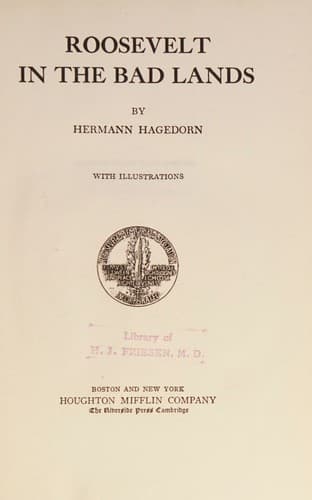
Biography; Frontier and pioneer life -- Dakota Territory; Roosevelt, Theodore, 1858-1919
commences [so ran the order] at Medora, May 25, 1886; works
down the Little Missouri to the mouth of Big Beaver Creek;
thence up the Big Beaver to its head; thence across to the
Little Beaver at the crossing of the old government road
(Keogh trail); thence down Little Beaver to its mouth;
thence across to Northern Hash-knife Camp on Little
Missouri, and down to Medora. John Goodall, foreman.
Roosevelt apparently could not resist the temptation which the
round-up offered, especially as its course would take him back in the
direction of Elkhorn, and he deserted his study and entered once more
into what was to him the most fascinating activity of the cowboy's
life.
There were half a dozen wagons along [he wrote
subsequently]. The saddle bands numbered about a hundred
each; and the morning we started, sixty men in the saddle
splashed across the shallow ford of the river that divided
the plain where we had camped from the valley of the long
winding creek up which we were first to work.
By the 7th of June he was back at Elkhorn Ranch again on a flying
visit.
I will get a chance to send this note to-morrow [he wrote
his sister "Bamie"] by an old teamster who is going to town.
I have been on the round-up for a fortnight, and really
enjoy the work greatly; in fact I am having a most pleasant
summer, though I miss all of you very, very much. We
breakfast at three and work from sixteen to eighteen hours a
day counting night-guard; so I get pretty sleepy; but I feel
as strong as a bear. I took along Tolstoy's "La Guerre et La
Paix" which Madame de Mores had lent me; but I have had
little chance to read it as yet. I am very fond of Tolstoy.
In "The Wilderness Hunter" Roosevelt, two or three years later, told
of that "very pleasant summer" of 1886.
I was much at the ranch, where I had a good deal of writing
to do; but every week or two I left, to ride among the line
camps, or spend a few days on any round-up which happened to
be in the neighborhood.
These days of vigorous work among the cattle were themselves
full of pleasure. At dawn we were in the saddle, the morning
air cool in our faces; the red sunrise saw us loping across
the grassy reaches of prairie land, or climbing in single
file among the rugged buttes. All forenoon we spent riding
the long circle with the cowpunchers of the round-up; in the
afternoon we worked the herd, cutting the cattle, with much
breakneck galloping and dextrous halting and wheeling. Then
came the excitement and hard labor of roping, throwing, and
branding the wild and vigorous range calves; in a corral, if
one was handy, otherwise in a ring of horsemen. Soon after
nightfall we lay down, in a log hut or tent, if at a line
camp; under the open sky, if with the round-up wagon.
Public-domain text, read in full here on John Shaqi.
Reviews
Reviews
No reviews yet
Be the first to share your thoughts on this work.
Elsewhere in the archive
Join the Discussion
Join the discussion
Sign in to leave a comment or review.
Sign InorCreate an account